Ch. 10 - Reactions of Alcohols, Ethers, Epoxides, Amines, and Sulfur-Containing Compounds
Bruice - Organic Chemistry 8th Edition
Bruice8th EditionOrganic ChemistryISBN: 9780135213711Not the one you use?Change textbook
Chapter 11, Problem 12a

Show how 1-propanol can be converted into the following compounds by means of a sulfonate ester:
a. CH3CH2CH2SCH2CH3

Verified step by step guidance
1
Step 1: Begin by converting 1-propanol (CH3CH2CH2OH) into a sulfonate ester. This can be achieved by reacting 1-propanol with a sulfonyl chloride, such as p-toluenesulfonyl chloride (TsCl), in the presence of a base like pyridine. This reaction replaces the hydroxyl group (-OH) with a tosyl group (-OTs), forming CH3CH2CH2OTs.
Step 2: The sulfonate ester (CH3CH2CH2OTs) is now a good leaving group, which facilitates substitution reactions. To introduce the desired thiol group (-SCH2CH3), perform a nucleophilic substitution reaction (SN2 mechanism) using ethanethiol (CH3CH2SH) as the nucleophile.
Step 3: In the SN2 reaction, the ethanethiol attacks the carbon attached to the tosyl group in CH3CH2CH2OTs, displacing the tosyl group and forming CH3CH2CH2SCH2CH3. Ensure the reaction is carried out in an appropriate solvent, such as acetone, to favor the SN2 mechanism.
Step 4: After the reaction, purify the product (CH3CH2CH2SCH2CH3) using techniques such as distillation or chromatography to remove any unreacted starting materials and by-products.
Step 5: Confirm the structure of the final product (CH3CH2CH2SCH2CH3) using spectroscopic methods such as NMR or IR to verify the presence of the thiol group and the absence of the tosyl group.

Verified video answer for a similar problem:

This video solution was recommended by our tutors as helpful for the problem above.
Video duration:
2m
Was this helpful?

Key Concepts

Here are the essential concepts you must grasp in order to answer the question correctly.

Sulfonate Esters

Sulfonate esters are derivatives of alcohols where the hydroxyl group (-OH) is replaced by a sulfonate group (-OSO2R). They are important in organic synthesis as they can be converted into various nucleophiles through nucleophilic substitution reactions. This transformation enhances the leaving group ability, facilitating the formation of carbon-carbon bonds or other functional groups.
Recommended video:
Guided course
02:39
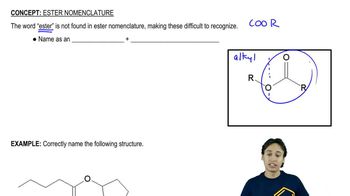
Ester Nomenclature

Nucleophilic Substitution Reactions

Nucleophilic substitution reactions involve the replacement of a leaving group in a molecule with a nucleophile. In the context of sulfonate esters, the sulfonate group acts as a good leaving group, allowing nucleophiles to attack the carbon atom bonded to it. This mechanism is crucial for converting 1-propanol into more complex structures, such as the desired thioether in the question.
Recommended video:
Guided course
01:47
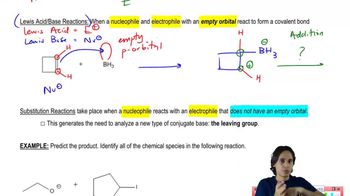
Nucleophiles and Electrophiles can react in Substitution Reactions.

Thioether Formation

Thioethers, also known as sulfides, are organic compounds containing a sulfur atom bonded to two alkyl or aryl groups. The formation of thioethers from alcohols typically involves the reaction of a sulfonate ester with a thiol (R-SH). Understanding this reaction is essential for synthesizing the target compound from 1-propanol, as it illustrates how to create carbon-sulfur bonds effectively.
Recommended video:
Guided course
02:26
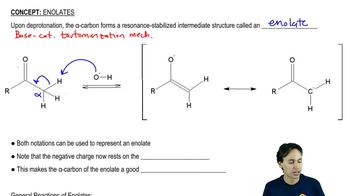
Formation of Enolates