Ch. 10 - Reactions of Alcohols, Ethers, Epoxides, Amines, and Sulfur-Containing Compounds
Bruice - Organic Chemistry 8th Edition
Bruice8th EditionOrganic ChemistryISBN: 9780135213711Not the one you use?Change textbook
Chapter 11, Problem 11c

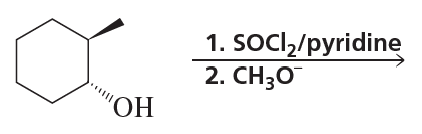
What stereoisomers do the following reactions form?
c. Chemical reaction diagram showing a hexagonal ring with an OH group, indicating substitution steps with reagents.

Verified step by step guidance
1
Step 1: Analyze the starting material. The given compound is a cyclobutane ring with an alcohol (-OH) group attached to one of the carbons. The stereochemistry of the alcohol group is shown as a wedge, indicating it is above the plane of the ring.
Step 2: Examine the first reaction step. Thionyl chloride (SOCl₂) in the presence of pyridine is used to convert the alcohol group into a chloride (-Cl) group. This reaction proceeds via an SN2 mechanism, which inverts the stereochemistry of the substituent. Therefore, the chloride group will be below the plane of the ring (dash).
Step 3: Consider the second reaction step. Ethoxide ion (C₂H₅O⁻) acts as a nucleophile and performs an SN2 substitution on the alkyl chloride. Since SN2 reactions also invert stereochemistry, the ethoxy group (-OCH₂CH₃) will replace the chloride and end up above the plane of the ring (wedge).
Step 4: Determine the stereoisomer formed. The final product will have the ethoxy group (-OCH₂CH₃) above the plane of the cyclobutane ring, maintaining the stereochemical inversion from the first step and the second step.
Step 5: Summarize the stereochemical outcome. The reaction sequence results in a stereoisomer where the ethoxy group is in the same stereochemical position as the original alcohol group (above the plane of the ring), due to two consecutive inversions of stereochemistry.

Verified video answer for a similar problem:

This video solution was recommended by our tutors as helpful for the problem above.
Video duration:
3m
Was this helpful?

Key Concepts

Here are the essential concepts you must grasp in order to answer the question correctly.

Stereoisomerism

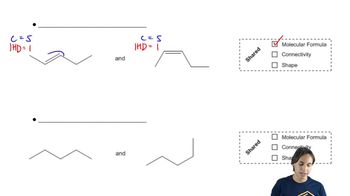
Stereoisomerism refers to the phenomenon where compounds have the same molecular formula and connectivity of atoms but differ in the spatial arrangement of their atoms. This can lead to different physical and chemical properties. The two main types of stereoisomers are enantiomers, which are non-superimposable mirror images, and diastereomers, which are not mirror images of each other.
Recommended video:
Guided course
01:58
Determining when molecules are stereoisomers.

Substitution Reactions

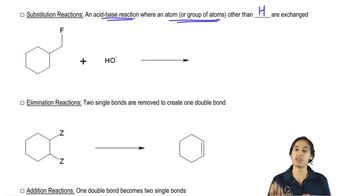
Substitution reactions involve the replacement of one functional group in a molecule with another. In the context of the provided reaction, thionyl chloride (SOCl2) is used to convert an alcohol into a better leaving group, facilitating the substitution by the nucleophile (C2H5O−). Understanding the mechanism of these reactions is crucial for predicting the stereochemical outcomes.
Recommended video:
Guided course
01:34
Recognizing Substitution Reactions.

Nucleophilic Attack and Stereochemistry

In nucleophilic substitution reactions, the nucleophile attacks the electrophilic carbon, leading to the formation of new bonds. The stereochemistry of the product depends on whether the reaction proceeds via an SN1 or SN2 mechanism. SN2 reactions are characterized by a backside attack, resulting in inversion of configuration, while SN1 reactions can lead to racemization due to the formation of a planar carbocation intermediate.
Recommended video:
1:38
Polymer Stereochemistry Concept 1