Ch. 10 - Reactions of Alcohols, Ethers, Epoxides, Amines, and Sulfur-Containing Compounds
Bruice - Organic Chemistry 8th Edition
Bruice8th EditionOrganic ChemistryISBN: 9780135213711Not the one you use?Change textbook
Chapter 11, Problem 12b

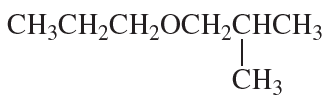
Show how 1-propanol can be converted into the following compounds by means of a sulfonate ester:
b. Structural formula showing the conversion of 1-propanol to a sulfonate ester with a branched alkyl group.

Verified step by step guidance
1
Step 1: Begin by converting 1-propanol into a sulfonate ester. This is achieved by reacting 1-propanol with a sulfonyl chloride, such as p-toluenesulfonyl chloride (TsCl), in the presence of a base like pyridine. The hydroxyl group (-OH) of 1-propanol is replaced with a tosyl group (-OTs), forming propyl tosylate.
Step 2: The sulfonate ester (propyl tosylate) is now a good leaving group due to the stability of the tosylate ion. This makes it suitable for substitution reactions. Choose the appropriate nucleophile depending on the desired product. For example, if you want to form an alkyl halide, use a halide ion (e.g., Cl⁻, Br⁻, or I⁻) as the nucleophile.
Step 3: Perform the nucleophilic substitution reaction (SN2 mechanism). The nucleophile attacks the carbon attached to the tosyl group, displacing the tosylate ion and forming the desired product. Ensure the reaction conditions are suitable for SN2, such as using a polar aprotic solvent like acetone or DMSO.
Step 4: If the desired compound requires further functional group modification, perform additional reactions. For example, if you need an alkene, you can eliminate the tosylate group using a strong base (e.g., NaOH or KOH) under heat to induce an E2 elimination reaction.
Step 5: Verify the structure of the final product using spectroscopic techniques such as NMR or IR to confirm the successful conversion of 1-propanol into the desired compound.

Verified video answer for a similar problem:

This video solution was recommended by our tutors as helpful for the problem above.
Video duration:
2m
Was this helpful?

Key Concepts

Here are the essential concepts you must grasp in order to answer the question correctly.

Sulfonate Esters

Sulfonate esters are derivatives of alcohols where the hydroxyl group (-OH) is replaced by a sulfonate group (-OSO2R). They are important intermediates in organic synthesis because they can undergo nucleophilic substitution reactions, allowing for the conversion of alcohols into more reactive species. This transformation enhances the electrophilicity of the carbon atom bonded to the sulfonate group, facilitating further reactions.
Recommended video:
Guided course
02:39
Ester Nomenclature

Nucleophilic Substitution Reactions

Nucleophilic substitution reactions involve the replacement of a leaving group in a molecule by a nucleophile. In the context of sulfonate esters, the sulfonate group acts as a good leaving group, allowing nucleophiles to attack the carbon atom. This reaction can follow either an SN1 or SN2 mechanism, depending on the structure of the substrate and the conditions, influencing the stereochemistry and rate of the reaction.
Recommended video:
Guided course
01:47
Nucleophiles and Electrophiles can react in Substitution Reactions.

Conversion of Alcohols to Alkyl Halides

The conversion of alcohols to alkyl halides is a common transformation in organic chemistry, often achieved through the formation of sulfonate esters. This process allows for the substitution of the hydroxyl group with a halide, enabling the synthesis of various alkyl halides. This transformation is significant for creating more reactive intermediates that can participate in further chemical reactions, such as coupling or elimination.
Recommended video:
Guided course
01:52
How to name alkyl halides