Ch. 10 - Reactions of Alcohols, Ethers, Epoxides, Amines, and Sulfur-Containing Compounds
Bruice - Organic Chemistry 8th Edition
Bruice8th EditionOrganic ChemistryISBN: 9780135213711Not the one you use?Change textbook
Chapter 11, Problem 15a

Heating an alcohol with sulfuric acid is a good way to prepare a symmetrical ether such as diethyl ether.
a. Explain why it is not a good way to prepare an unsymmetrical ether such as ethyl propyl ether.

Verified step by step guidance
1
Understand the reaction mechanism: The preparation of ethers using alcohols and sulfuric acid typically follows the Williamson ether synthesis mechanism. This involves the protonation of the alcohol by sulfuric acid, forming a good leaving group, and subsequent nucleophilic attack by another alcohol molecule.
Recognize the limitation for unsymmetrical ethers: When two different alcohols (e.g., ethanol and propanol) are used, both alcohols can act as nucleophiles and electrophiles. This leads to a mixture of products, including symmetrical ethers (e.g., diethyl ether and dipropyl ether) and the desired unsymmetrical ether (e.g., ethyl propyl ether).
Consider the statistical likelihood: The formation of the unsymmetrical ether is not favored because the reaction does not discriminate between the two alcohols. As a result, the reaction produces a mixture of products, making it inefficient for preparing a pure unsymmetrical ether.
Account for steric and electronic effects: In some cases, steric hindrance or electronic effects may further reduce the yield of the unsymmetrical ether. For example, a bulky alcohol may hinder the nucleophilic attack, favoring the formation of symmetrical ethers.
Conclude with an alternative method: To prepare an unsymmetrical ether like ethyl propyl ether, a more controlled method such as the Williamson ether synthesis using an alkoxide and an alkyl halide is preferred. This method allows for better control over the reactants and product selectivity.

Verified video answer for a similar problem:

This video solution was recommended by our tutors as helpful for the problem above.
Video duration:
5m
Was this helpful?

Key Concepts

Here are the essential concepts you must grasp in order to answer the question correctly.

Ethanol Dehydration

Heating an alcohol with sulfuric acid typically leads to dehydration, where water is removed, resulting in the formation of alkenes. In the case of symmetrical ethers, the reaction can proceed through the formation of a symmetrical alkene, which can then react with an alcohol to form the ether. However, this process is less favorable for unsymmetrical ethers, as it can lead to a mixture of products.
Recommended video:
Guided course
01:23
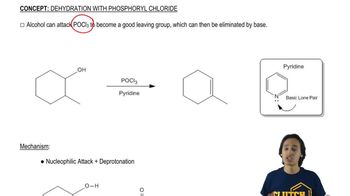
General Reaction of Dehydration with POCl3

Rearrangement Reactions

During the dehydration of alcohols, carbocation intermediates can form, which may undergo rearrangements to create more stable carbocations. This rearrangement can lead to the formation of different products, complicating the synthesis of unsymmetrical ethers. The presence of different alkyl groups can also lead to competing pathways, making it difficult to control the reaction outcome.
Recommended video:
Guided course
06:28
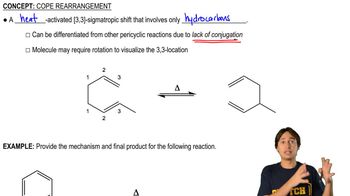
Definition of Cope Rearrangement

Selectivity in Ether Formation

The selectivity of ether formation is influenced by the structure of the reactants. For symmetrical ethers, the reaction can favor the formation of a single product due to the identical nature of the reactants. In contrast, unsymmetrical ethers involve different alkyl groups, leading to multiple possible products and lower selectivity, making it challenging to achieve a desired unsymmetrical ether through this method.
Recommended video:
Guided course
04:22
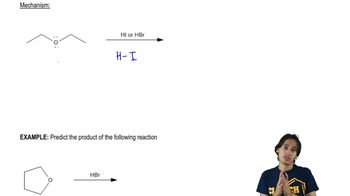
How to predict the products of Ether Cleavage.