Ch. 10 - Reactions of Alcohols, Ethers, Epoxides, Amines, and Sulfur-Containing Compounds
Bruice - Organic Chemistry 8th Edition
Bruice8th EditionOrganic ChemistryISBN: 9780135213711Not the one you use?Change textbook
Chapter 11, Problem 18

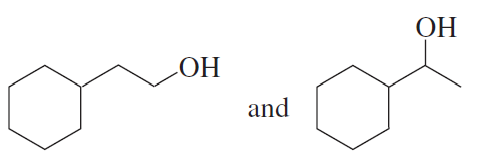
Explain why the following alcohols, when heated with acid, form the same alkene.
Two structural formulas of alcohols with hydroxyl groups, illustrating their dehydration reaction to form the same alkene.

Verified step by step guidance
1
Step 1: Analyze the structures of the two alcohols. Both alcohols have a cyclopentane ring and differ in the position of the hydroxyl (-OH) group. The first alcohol has the -OH group on a primary carbon, while the second alcohol has the -OH group on a secondary carbon.
Step 2: Understand the reaction mechanism. When alcohols are heated with acid, they undergo an elimination reaction (E1 mechanism) to form alkenes. The reaction begins with protonation of the hydroxyl group, converting it into a better leaving group (water).
Step 3: Consider carbocation formation. After the leaving group departs, a carbocation intermediate is formed. The stability of the carbocation plays a crucial role in determining the product. In both cases, the carbocation formed is a secondary carbocation adjacent to the cyclopentane ring.
Step 4: Examine the possibility of rearrangement. Carbocations can undergo hydride or alkyl shifts to form more stable carbocations. In this case, no rearrangement is needed because the secondary carbocation is already stable.
Step 5: Determine the final alkene product. The elimination of a proton from the carbocation leads to the formation of the same alkene in both cases. The double bond forms between the cyclopentane ring and the adjacent carbon, resulting in the same alkene product regardless of the starting alcohol.

Verified video answer for a similar problem:

This video solution was recommended by our tutors as helpful for the problem above.
Video duration:
7m
Was this helpful?

Key Concepts

Here are the essential concepts you must grasp in order to answer the question correctly.

Dehydration of Alcohols

Dehydration of alcohols involves the removal of a water molecule, typically in the presence of an acid catalyst, leading to the formation of alkenes. This reaction is an elimination process where the hydroxyl group (-OH) is removed along with a hydrogen atom from an adjacent carbon, resulting in a double bond. The structure of the alcohol influences the stability of the resulting alkene, often favoring more substituted alkenes due to their greater stability.
Recommended video:
Guided course
01:23
General Reaction of Dehydration with POCl3

Zaitsev's Rule

Zaitsev's Rule states that in elimination reactions, the more substituted alkene is generally the major product. This occurs because more substituted alkenes are more stable due to hyperconjugation and the inductive effect. When two different alcohols yield the same alkene upon dehydration, it suggests that both structures allow for the formation of the same stable alkene, adhering to Zaitsev's principle.
Recommended video:
Guided course
01:18
Defining Zaitsev’s Rule

Carbocation Stability

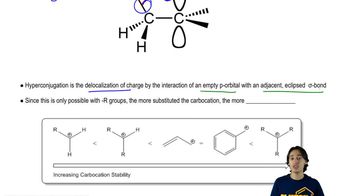
Carbocation stability is a crucial factor in determining the outcome of dehydration reactions. Carbocations are positively charged carbon species that can form during the elimination process. The stability of these intermediates increases with the degree of substitution; tertiary carbocations are more stable than secondary or primary ones. In the case of the given alcohols, the formation of a common carbocation intermediate leads to the same alkene product, regardless of the starting alcohol structure.
Recommended video:
Guided course
05:58
Determining Carbocation Stability