Ch. 10 - Reactions of Alcohols, Ethers, Epoxides, Amines, and Sulfur-Containing Compounds
Bruice - Organic Chemistry 8th Edition
Bruice8th EditionOrganic ChemistryISBN: 9780135213711Not the one you use?Change textbook
Chapter 11, Problem 20

If the compound shown in the margin is heated in the presence of H2SO4,
a. what constitutional isomer would be formed in greatest yield?
b. what stereoisomer would be formed in greater yield?
Chemical structure of a compound with an OH group and a CH3 group, relevant to dehydration reactions.

Verified step by step guidance
1
Analyze the given compound: The structure shows a cyclohexane ring with a secondary alcohol (-OH group) attached to a carbon that also has a methyl group (-CH3). This is a secondary alcohol.
Understand the reaction conditions: Heating in the presence of H2SO4 (sulfuric acid) typically leads to an elimination reaction (E1 mechanism) where the alcohol is converted into an alkene via dehydration.
Determine the major constitutional isomer: The E1 mechanism proceeds through the formation of a carbocation intermediate. The most stable carbocation will form, which in this case is the secondary carbocation. The elimination will follow Zaitsev's rule, favoring the formation of the more substituted alkene. This means the double bond will likely form between the carbon bearing the -OH group and the adjacent carbon in the ring.
Consider stereoisomer formation: The elimination reaction can produce stereoisomers (E/Z isomers) depending on the spatial arrangement of substituents around the double bond. The major stereoisomer will be the one with the substituents in the most stable configuration, typically the E-isomer (trans configuration) due to reduced steric hindrance.
Summarize the expected products: The major constitutional isomer will be the more substituted alkene formed via Zaitsev's rule, and the major stereoisomer will be the E-isomer due to its stability.

Verified video answer for a similar problem:

This video solution was recommended by our tutors as helpful for the problem above.
Video duration:
4m
Was this helpful?

Key Concepts

Here are the essential concepts you must grasp in order to answer the question correctly.

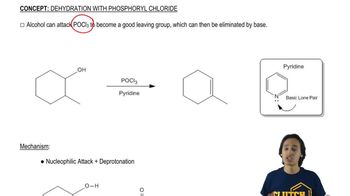
Dehydration Reactions

Dehydration reactions involve the removal of a water molecule from a compound, typically resulting in the formation of a double bond. In organic chemistry, this process is common for alcohols when heated in the presence of an acid, such as sulfuric acid (H2SO4). The reaction can lead to the formation of alkenes, which can have multiple structural isomers depending on the position of the double bond.
Recommended video:
Guided course
01:23
General Reaction of Dehydration with POCl3

Constitutional Isomers

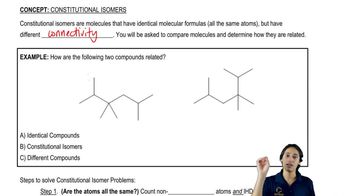
Constitutional isomers are compounds that have the same molecular formula but differ in the connectivity of their atoms. This means that the atoms are arranged in different ways, leading to distinct compounds with unique properties. In the context of dehydration reactions, the formation of different constitutional isomers can occur based on how the double bond is formed during the elimination of water.
Recommended video:
Guided course
01:10
What is a constitutional isomer?

Stereoisomers

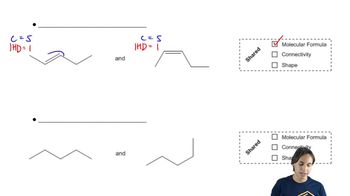
Stereoisomers are compounds that have the same molecular formula and connectivity of atoms but differ in the spatial arrangement of their atoms. This can lead to different physical and chemical properties. In dehydration reactions, stereoisomer formation is influenced by the orientation of substituents around the double bond, which can result in cis/trans or E/Z isomers depending on the substituents' positions.
Recommended video:
Guided course
01:58
Determining when molecules are stereoisomers.