Ch. 10 - Reactions of Alcohols, Ethers, Epoxides, Amines, and Sulfur-Containing Compounds
Bruice - Organic Chemistry 8th Edition
Bruice8th EditionOrganic ChemistryISBN: 9780135213711Not the one you use?Change textbook
Chapter 11, Problem 22c(1,2,3)

What product is obtained from the reaction of each of the following alcohols with
c. the regents required for a Swern oxidation?
1. 3-pentanol
2. 1-pentanol
3. 2-methyl-2-pentanol

Verified step by step guidance
1
Identify the type of alcohol in each case (primary, secondary, or tertiary) since the Swern oxidation mechanism depends on the type of alcohol.
Recall that Swern oxidation converts primary alcohols to aldehydes and secondary alcohols to ketones, while tertiary alcohols do not undergo oxidation under these conditions.
For 3-pentanol (a secondary alcohol), predict that it will be oxidized to a ketone. The carbon attached to the hydroxyl group will lose a hydrogen, forming a carbonyl group.
For 1-pentanol (a primary alcohol), predict that it will be oxidized to an aldehyde. The hydroxyl group will be replaced by a carbonyl group, and no further oxidation to a carboxylic acid occurs under Swern conditions.
For 2-methyl-2-pentanol (a tertiary alcohol), note that it will not react under Swern oxidation conditions because tertiary alcohols lack a hydrogen atom on the carbon bearing the hydroxyl group, which is necessary for oxidation.

Verified video answer for a similar problem:

This video solution was recommended by our tutors as helpful for the problem above.
Video duration:
4m
Was this helpful?

Key Concepts

Here are the essential concepts you must grasp in order to answer the question correctly.

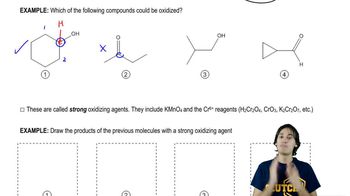
Swern Oxidation

Swern oxidation is a method used to convert alcohols into aldehydes or ketones using a combination of oxalyl chloride, dimethyl sulfoxide (DMSO), and a base such as triethylamine. This reaction is notable for its mild conditions and selectivity, allowing for the oxidation of primary and secondary alcohols without over-oxidation to carboxylic acids.
Recommended video:
Guided course
03:40
Strong oxidizing agents

Alcohol Classification

Alcohols are classified based on the number of carbon atoms bonded to the carbon bearing the hydroxyl (-OH) group. Primary alcohols have one carbon attached, secondary alcohols have two, and tertiary alcohols have three. This classification is crucial for predicting the products of oxidation reactions, as the structure influences the outcome.
Recommended video:
Guided course
07:17
Structural Classification

Product Formation in Oxidation

The product of an alcohol oxidation depends on its classification. Primary alcohols typically yield aldehydes, secondary alcohols produce ketones, and tertiary alcohols do not oxidize to carbonyls under Swern conditions. Understanding these transformations is essential for determining the expected products from the given alcohols in the question.
Recommended video:
Guided course
04:02
Predict the products of the following oxidative cleavage