Ch. 11 - Properties and Synthesis of Alkyl Halides: Radical Reactions
Mullins - Organic Chemistry: A Learner Centered Approach 1st Edition
Mullins1st EditionOrganic Chemistry: A Learner Centered ApproachISBN: 9780137566471Not the one you use?Change textbook
Chapter 10, Problem 47a

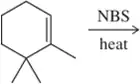
Predict the major product(s) of the following allylic bromination reactions.
(a) Chemical reaction diagram: cyclohexene with methyl groups reacts with NBS under heat to form allylic bromination product.

Verified step by step guidance
1
Identify the allylic position in the given molecule. The allylic position is the carbon atom adjacent to a double bond.
Consider the mechanism of allylic bromination, which typically involves the formation of an allylic radical. This occurs through the abstraction of a hydrogen atom from the allylic position by a bromine radical.
Once the allylic radical is formed, it can resonate to form different radical structures. Identify all possible resonance structures of the allylic radical to determine the stability and possible sites for bromine addition.
Select the most stable allylic radical structure based on resonance and hyperconjugation effects. The stability of the radical will influence the major product formed.
Add a bromine atom to the most stable allylic radical position to predict the major product of the reaction. Consider regioselectivity and the possibility of multiple products if there are equivalent allylic positions.

Verified video answer for a similar problem:

This video solution was recommended by our tutors as helpful for the problem above.
Video duration:
3m
Was this helpful?

Key Concepts

Here are the essential concepts you must grasp in order to answer the question correctly.

Allylic Bromination

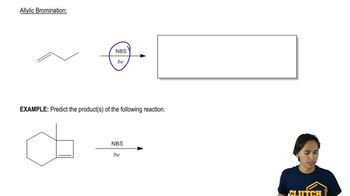
Allylic bromination is a reaction where a bromine atom is introduced at the allylic position of an alkene. This process typically involves the use of N-bromosuccinimide (NBS) in the presence of light or heat, which generates bromine radicals that selectively react with the allylic hydrogen, leading to the formation of an allylic bromide.
Recommended video:
Guided course
00:54
Mechanism of Allylic Bromination.

Radical Mechanism

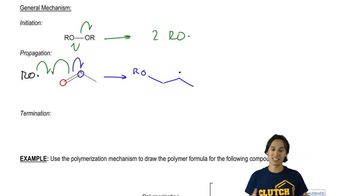
The radical mechanism is crucial for understanding allylic bromination. It involves the generation of bromine radicals that abstract hydrogen atoms from the allylic position, forming a radical intermediate. This intermediate then reacts with another bromine radical to form the allylic bromide product. The stability of the radical intermediate often dictates the major product formed.
Recommended video:
Guided course
03:28
The mechanism of Radical Polymerization.

Regioselectivity

Regioselectivity refers to the preference for the formation of one constitutional isomer over others in a chemical reaction. In allylic bromination, the most stable radical intermediate is typically formed, which leads to the major product. Factors such as resonance stabilization and steric effects influence which allylic position is preferentially brominated.
Recommended video:
Guided course
05:09
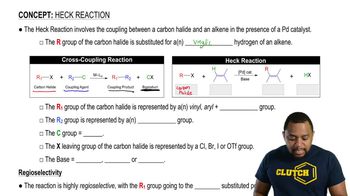
Heck Reaction