Ch. 11 - Properties and Synthesis of Alkyl Halides: Radical Reactions
Mullins - Organic Chemistry: A Learner Centered Approach 1st Edition
Mullins1st EditionOrganic Chemistry: A Learner Centered ApproachISBN: 9780137566471Not the one you use?Change textbook
Chapter 10, Problem 47d

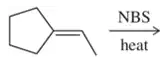
Predict the major product(s) of the following allylic bromination reactions.
(d)

Verified step by step guidance
1
Identify the allylic position in the given molecule. The allylic position is the carbon atom adjacent to the double bond. In this case, the allylic position is the carbon atom in the pentene ring adjacent to the double bond.
Understand the role of N-bromosuccinimide (NBS) in the reaction. NBS is used for allylic bromination, which selectively brominates the allylic position in the presence of heat or light.
Consider the formation of the allylic radical. The reaction proceeds via a radical mechanism where the allylic hydrogen is abstracted, forming an allylic radical.
Determine the resonance stabilization of the allylic radical. The allylic radical can be stabilized by resonance, allowing the radical to delocalize over the π system of the double bond.
Predict the major product by adding a bromine atom to the allylic radical. The bromine atom from NBS will add to the allylic radical, resulting in the formation of the allylic bromide as the major product.

Verified video answer for a similar problem:

This video solution was recommended by our tutors as helpful for the problem above.
Was this helpful?

Key Concepts

Here are the essential concepts you must grasp in order to answer the question correctly.

Allylic Bromination

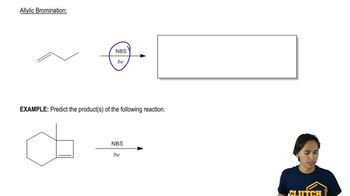
Allylic bromination is a reaction where bromine is introduced at the allylic position of an alkene. This position is adjacent to the double bond, allowing for resonance stabilization of the radical intermediate formed during the reaction. The use of N-bromosuccinimide (NBS) in the presence of heat facilitates the generation of bromine radicals necessary for this transformation.
Recommended video:
Guided course
00:54
Mechanism of Allylic Bromination.

Radical Mechanism

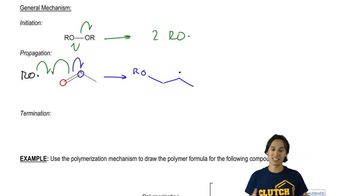
The radical mechanism involves the formation of radical intermediates, which are highly reactive species with unpaired electrons. In allylic bromination, the reaction proceeds through a radical chain mechanism, starting with the homolytic cleavage of NBS to generate bromine radicals, which then abstract hydrogen from the allylic position, forming a stabilized allylic radical that reacts with bromine to form the brominated product.
Recommended video:
Guided course
03:28
The mechanism of Radical Polymerization.

Resonance Stabilization

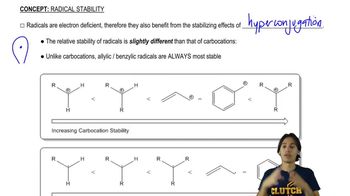
Resonance stabilization is a key concept in organic chemistry where certain intermediates, such as radicals or carbocations, are stabilized by the delocalization of electrons across adjacent pi systems. In allylic bromination, the allylic radical formed is stabilized by resonance, allowing the radical to be distributed over multiple atoms, which lowers the energy of the intermediate and facilitates the reaction.
Recommended video:
Guided course
03:43
The radical stability trend.