Ch. 11 - Properties and Synthesis of Alkyl Halides: Radical Reactions
Mullins - Organic Chemistry: A Learner Centered Approach 1st Edition
Mullins1st EditionOrganic Chemistry: A Learner Centered ApproachISBN: 9780137566471Not the one you use?Change textbook
Chapter 10, Problem 48b

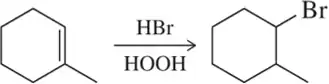
Suggest a mechanism for the following reactions.
(b) Chemical reaction showing cyclohexene reacting with HBr and HOOH to form bromocyclohexane via anti-Markovnikov addition.

Verified step by step guidance
1
Identify the type of reaction: Determine if the reaction is an addition, elimination, substitution, or rearrangement. This will guide the mechanism you propose.
Analyze the reactants and products: Look at the functional groups present in the reactants and products. This will help you understand what transformations are occurring.
Determine the key intermediates: Consider any carbocations, carbanions, radicals, or other intermediates that might form during the reaction. These are often crucial for understanding the mechanism.
Propose the step-by-step mechanism: Start with the initial reactants and show how they transform into intermediates and then into products. Use curved arrows to indicate the movement of electrons.
Consider stereochemistry and regiochemistry: If applicable, think about how the reaction might affect the stereochemistry or regiochemistry of the molecules involved. This can be important for understanding the full mechanism.

Verified video answer for a similar problem:

This video solution was recommended by our tutors as helpful for the problem above.
Video duration:
9m
Was this helpful?

Key Concepts

Here are the essential concepts you must grasp in order to answer the question correctly.

Reaction Mechanism

A reaction mechanism is a detailed step-by-step description of how a chemical reaction occurs at the molecular level. It includes the sequence of elementary steps, the movement of electrons, and the formation and breaking of bonds. Understanding mechanisms helps predict the products and intermediates formed during the reaction.
Recommended video:
Guided course
02:16
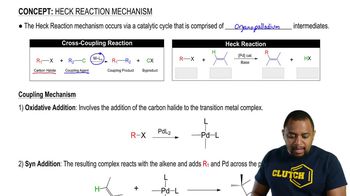
Heck Reaction Mechanism

Electrophiles and Nucleophiles

Electrophiles are species that seek electrons and are typically positively charged or electron-deficient, while nucleophiles are electron-rich species that donate electrons. Identifying electrophiles and nucleophiles in a reaction is crucial for understanding how reactants interact and form products, as they dictate the direction and nature of the electron flow.
Recommended video:
Guided course
03:
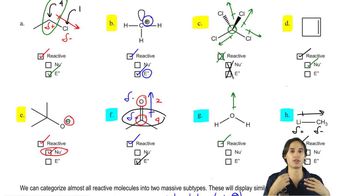
Nucleophile or Electrophile

Transition States and Intermediates

Transition states are high-energy states that occur during the conversion of reactants to products, representing the point of maximum energy along the reaction path. Intermediates are species formed between reactants and products that are often short-lived. Recognizing these helps in mapping out the energy profile and stability of the reaction pathway.
Recommended video:
Guided course
06:55
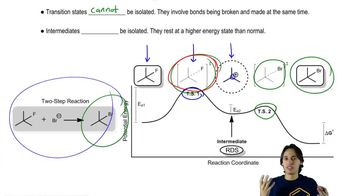
Intermediates vs. Transition States