Ch. 16 - Metals in Organic Chemistry
Mullins - Organic Chemistry: A Learner Centered Approach 1st Edition
Mullins1st EditionOrganic Chemistry: A Learner Centered ApproachISBN: 9780137566471Not the one you use?Change textbook
Chapter 15, Problem 35

Suggest a synthesis of the following molecule starting with the reagents shown, using cuprate cross-coupling as the key step.
Chemical reaction diagram showing the synthesis of a molecule using cuprate cross-coupling with specified reagents.

Verified step by step guidance
1
Identify the key transformation needed: The target molecule is formed by connecting the aromatic ring of the iodide compound to the alkyl chain of the alcohol. This suggests a cross-coupling reaction.
Prepare the organocuprate reagent: Convert the alcohol into an organometallic compound. This can be done by first converting the alcohol to a halide (e.g., using PBr3 to form the corresponding alkyl bromide), and then reacting it with a copper(I) reagent to form the organocuprate.
Perform the cuprate cross-coupling: Use the organocuprate reagent to perform a cross-coupling reaction with the aryl iodide. This step will form the carbon-carbon bond between the aromatic ring and the alkyl chain.
Consider the reaction conditions: Ensure that the reaction is carried out under conditions suitable for cuprate coupling, typically involving a polar aprotic solvent and low temperatures to stabilize the organocuprate.
Verify the synthesis: Analyze the structure of the product to ensure that the desired carbon-carbon bond has been formed and that the overall structure matches the target molecule.

Verified video answer for a similar problem:

This video solution was recommended by our tutors as helpful for the problem above.
Video duration:
7m
Was this helpful?

Key Concepts

Here are the essential concepts you must grasp in order to answer the question correctly.

Cuprate Cross-Coupling

Cuprate cross-coupling is a reaction involving organocopper reagents, typically lithium diorganocopper reagents, which react with electrophiles to form carbon-carbon bonds. This method is particularly useful for synthesizing complex organic molecules due to its ability to couple a wide range of substrates, including aryl and vinyl halides. Understanding the mechanism and conditions for this reaction is crucial for effectively utilizing it in synthetic pathways.
Recommended video:
Guided course
03:22
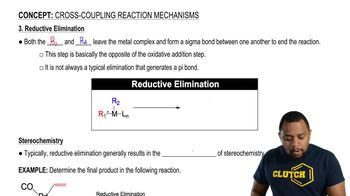
Cross-Coupling Reaction Mechanisms

Reagents and Reaction Conditions

The choice of reagents and reaction conditions is vital in organic synthesis, as they dictate the feasibility and efficiency of the desired transformation. In the context of cuprate cross-coupling, selecting the appropriate organocopper reagent and ensuring optimal conditions, such as temperature and solvent, can significantly influence the yield and selectivity of the product. Familiarity with the reactivity of different functional groups is essential for successful synthesis.
Recommended video:

Synthetic Strategy and Retrosynthesis

Synthetic strategy involves planning a sequence of reactions to construct a target molecule from simpler starting materials. Retrosynthesis is a technique used to work backward from the target molecule to identify suitable precursors and intermediates. This approach is critical in organic chemistry, as it helps chemists visualize the pathway to synthesize complex molecules, including the necessary reactions from previous chapters, such as those in Chapter 13.
Recommended video:
Guided course
01:22
Retrosynthesis