Based on the stereochemical result alone, how can you tell that this reaction does not proceed by an Sₙ2 mechanism?
Ch. 16 - Metals in Organic Chemistry

Mullins1st EditionOrganic Chemistry: A Learner Centered ApproachISBN: 9780137566471Not the one you use?Change textbook
Chapter 15, Problem 36a
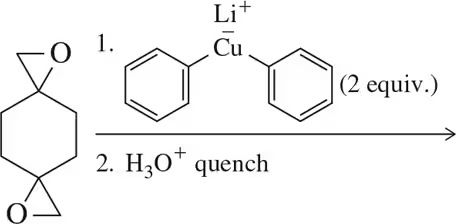
Predict the product of the following epoxide opening reactions.
(a) 
Verified step by step guidance1
Identify the structure of the epoxide. An epoxide is a cyclic ether with a three-membered ring, typically consisting of two carbon atoms and one oxygen atom.
Determine the conditions of the reaction. Epoxide opening can occur under acidic or basic conditions, which will influence the regioselectivity and stereochemistry of the product.
If the reaction is under acidic conditions, the nucleophile will attack the more substituted carbon atom of the epoxide due to the formation of a more stable carbocation intermediate.
If the reaction is under basic conditions, the nucleophile will attack the less substituted carbon atom of the epoxide due to steric hindrance and the direct SN2 mechanism.
Consider the stereochemistry of the reaction. Epoxide opening reactions often result in inversion of configuration at the carbon atom where the nucleophile attacks, due to the backside attack characteristic of SN2 reactions.

Verified video answer for a similar problem:
This video solution was recommended by our tutors as helpful for the problem above.
Was this helpful?
Key Concepts
Here are the essential concepts you must grasp in order to answer the question correctly.
Epoxide Structure
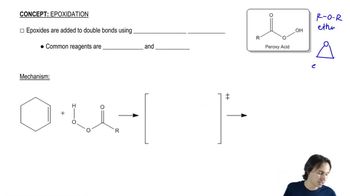
Epoxides are cyclic ethers with a three-membered ring consisting of two carbon atoms and one oxygen atom. The strained ring makes epoxides highly reactive, especially in nucleophilic reactions, where the ring can be opened to form more stable products.
Recommended video:
Guided course
General properties of epoxidation.
Nucleophilic Attack
In epoxide opening reactions, a nucleophile attacks the less hindered carbon atom of the epoxide ring, leading to ring opening. The nucleophile donates a pair of electrons to form a new bond, resulting in the formation of an alcohol or other functional group, depending on the nucleophile used.
Recommended video:
Guided course
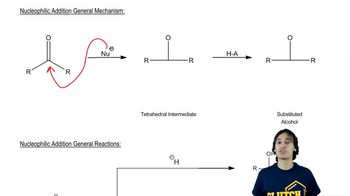
Nucleophilic Addition
Regioselectivity in Epoxide Opening
Regioselectivity refers to the preference for a chemical reaction to occur at one location over another in a molecule. In epoxide opening, the reaction can be influenced by the presence of acid or base, which affects which carbon atom the nucleophile attacks, often favoring the less substituted carbon in basic conditions.
Recommended video:
Guided course
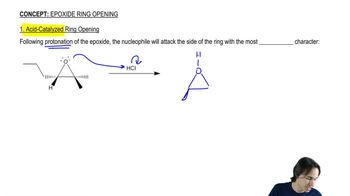
Acid-Catalyzed Epoxide Ring-Opening
Related Practice
Textbook Question
1
views
Textbook Question
Which of the following solvents are reasonable choices for a Grignard reaction? Justify your choices. [Hint: Carbonyls are good electrophiles.]
2
views
Textbook Question
Predict the product of the following epoxide opening reactions.
(b)
1
views
Textbook Question
The situation shown here is an example where a cuprate is the only organometallic that will allow the product alcohol to be obtained. What is the problem with using a Grignard or an organolithium to attempt the same reaction?
2
views
Textbook Question
Predict the product of the diorganocuprate cross-coupling reactions shown.
(c)
1
views
Textbook Question
Suggest a synthesis of the following molecule starting with the reagents shown, using cuprate cross-coupling as the key step.
2
views