Which of the following solvents are reasonable choices for a Grignard reaction? Justify your choices. [Hint: Carbonyls are good electrophiles.]
Ch. 16 - Metals in Organic Chemistry

Mullins1st EditionOrganic Chemistry: A Learner Centered ApproachISBN: 9780137566471Not the one you use?Change textbook
Chapter 15, Problem 37
The situation shown here is an example where a cuprate is the only organometallic that will allow the product alcohol to be obtained. What is the problem with using a Grignard or an organolithium to attempt the same reaction?

Verified step by step guidance1
Understand the nature of Grignard reagents and organolithium compounds: Both are strong nucleophiles and bases, which can react aggressively with electrophiles.
Recognize the functional groups involved: If the target molecule contains functional groups like carbonyls, Grignard and organolithium reagents can react with these groups, potentially leading to unwanted side reactions.
Consider the reactivity of cuprates: Cuprates are less reactive than Grignard and organolithium reagents, making them more selective in reactions where sensitive functional groups are present.
Identify the problem with Grignard and organolithium reagents: These reagents can react with acidic protons or electrophilic centers, leading to side reactions that prevent the formation of the desired alcohol.
Conclude why cuprates are preferred: Cuprates can perform conjugate additions and are less likely to react with acidic protons, making them suitable for obtaining the desired alcohol without side reactions.

Verified video answer for a similar problem:
This video solution was recommended by our tutors as helpful for the problem above.
Was this helpful?
Key Concepts
Here are the essential concepts you must grasp in order to answer the question correctly.
Cuprate Reagents
Cuprate reagents, typically lithium diorganocuprates, are organometallic compounds used in organic synthesis for nucleophilic substitution reactions. They are less reactive than Grignard or organolithium reagents, allowing for selective reactions with electrophiles without overreacting, which is crucial for obtaining specific products like alcohols in complex molecules.
Recommended video:
Guided course
Reagents
Grignard Reagents
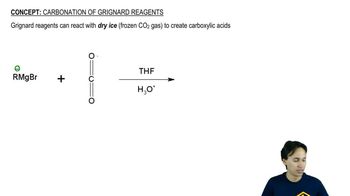
Grignard reagents are organomagnesium compounds used in organic chemistry to form carbon-carbon bonds. They are highly reactive and can react with a wide range of electrophiles, including carbonyl groups. However, their high reactivity can lead to side reactions or overreaction, making them unsuitable for reactions requiring selectivity, such as the formation of alcohols in sensitive substrates.
Recommended video:
Guided course
Carbonation of Grignard Reagents
Organolithium Reagents
Organolithium reagents are highly reactive organometallic compounds used for nucleophilic addition to carbonyl groups. Their strong basicity and reactivity can lead to unwanted side reactions, such as deprotonation or multiple additions, which can complicate the synthesis of target molecules like alcohols. This makes them less suitable for reactions requiring controlled reactivity compared to cuprates.
Recommended video:
Guided course
Reagents
Related Practice
Textbook Question
2
views
Textbook Question
A chemist failed to generate the alcohol using the reaction shown here.
(a) Suggest a reason why this reaction did not work as written.
2
views
Textbook Question
Predict the product of the following epoxide opening reactions.
(a)
5
views
Textbook Question
Predict the product of the following epoxide opening reactions.
(b)
1
views
Textbook Question
A chemist failed to generate the diol using the reaction shown here.
(a) Suggest a reason why this reaction did not work as written.
(b) How could the reaction conditions be modified to allow formation of the diol? [It may require more than one step.]
2
views
Textbook Question
Suggest a synthesis of the following molecule starting with the reagents shown, using cuprate cross-coupling as the key step.
2
views