Based on the stereochemical result alone, how can you tell that this reaction does not proceed by an Sₙ2 mechanism?
Ch. 16 - Metals in Organic Chemistry

Mullins1st EditionOrganic Chemistry: A Learner Centered ApproachISBN: 9780137566471Not the one you use?Change textbook
Chapter 15, Problem 33c
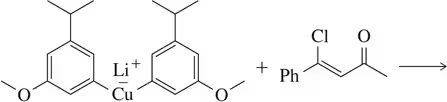
Predict the product of the diorganocuprate cross-coupling reactions shown.
(c) 
Verified step by step guidance1
Identify the reagents involved in the reaction. The diorganocuprate reagent is a lithium cuprate, specifically a (methoxyphenyl)2CuLi, and the substrate is a phenyl-substituted acyl chloride.
Understand the mechanism of the diorganocuprate reaction. Diorganocuprates are known for their ability to perform nucleophilic substitution reactions, particularly with acyl chlorides, leading to the formation of ketones.
Recognize the role of the cuprate reagent. In this reaction, one of the methoxyphenyl groups from the cuprate will act as a nucleophile and attack the carbonyl carbon of the acyl chloride, displacing the chloride ion.
Predict the structure of the product. The methoxyphenyl group will replace the chlorine atom in the acyl chloride, forming a new carbon-carbon bond and resulting in a ketone with a methoxyphenyl substituent.
Consider stereochemistry and regiochemistry. Since the reaction involves a straightforward nucleophilic acyl substitution, stereochemistry is not a concern here, and the regiochemistry is determined by the position of the acyl chloride group.

Verified video answer for a similar problem:
This video solution was recommended by our tutors as helpful for the problem above.
Was this helpful?
Key Concepts
Here are the essential concepts you must grasp in order to answer the question correctly.
Diorganocuprate Reagents
Diorganocuprates are organometallic compounds containing copper, typically represented as R2CuLi, where R is an organic group. They are used in cross-coupling reactions to form carbon-carbon bonds by transferring an organic group to an electrophile. Understanding their reactivity and how they interact with various substrates is crucial for predicting the products of these reactions.
Recommended video:
Guided course
Reagents
Cross-Coupling Reactions
Cross-coupling reactions are a class of reactions in organic chemistry where two different organic groups are joined together, typically facilitated by a metal catalyst. These reactions are essential for forming complex organic molecules and are widely used in the synthesis of pharmaceuticals and materials. Familiarity with the mechanisms and conditions of these reactions is vital for predicting the outcome of diorganocuprate reactions.
Recommended video:
Guided course
Cross-Coupling Reaction Mechanisms
Electrophiles and Nucleophiles
In organic chemistry, electrophiles are species that accept electron pairs from nucleophiles, which are electron-rich species that donate electron pairs. The interaction between these two types of species is fundamental in many reactions, including cross-coupling. Identifying the electrophile in the reaction and understanding its reactivity with the nucleophilic diorganocuprate is essential for predicting the final product.
Recommended video:
Guided course
Nucleophile or Electrophile
Related Practice
Textbook Question
1
views
Textbook Question
Predict the product of the diorganocuprate cross-coupling reactions shown.
(b)
1
views
Textbook Question
The trimethylsilyl (TMS) group, used as a protecting group for alcohols, can also be used a protecting group for terminal alkynes. Show how TMS-acetylene could be used to link together two aryl halides using the Sonogashira reaction. [Hint: Deprotection of the TMS-acetylene can be done using KF in H₂O.]
1
views
Textbook Question
Predict the product of the following epoxide opening reactions.
(a)
5
views
Textbook Question
Predict the product of the diorganocuprate cross-coupling reactions shown.
(a)
1
views
Textbook Question
Suggest a synthesis of the following molecule starting with the reagents shown, using cuprate cross-coupling as the key step.
2
views