Ch.10 - Structure and Synthesis of Alcohols
Wade - Organic Chemistry 9th Edition
Wade9th EditionOrganic ChemistryISBN: 9780135213728Not the one you use?Change textbook
Chapter 10, Problem 32d,e

Draw the structures of the following compounds. (Includes both new and old names.)
(d) 3-cyclopentylhexan-3-ol
(e) meso-2,4-pentanediol

Verified step by step guidance
1
Step 1: Begin by identifying the parent chain for each compound. For (d) 3-cyclopentylhexan-3-ol, the parent chain is hexane (a six-carbon chain). For (e) meso-2,4-pentanediol, the parent chain is pentane (a five-carbon chain).
Step 2: For (d), locate the substituent and functional group. The cyclopentyl group is attached to the third carbon of the hexane chain, and the hydroxyl (-OH) group is also attached to the third carbon. Draw the hexane chain first, then add the cyclopentyl group and hydroxyl group at the correct positions.
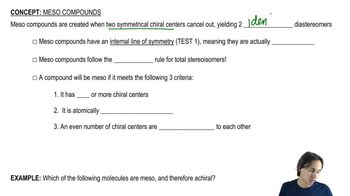
Step 3: For (e), note that meso compounds have internal symmetry and are optically inactive. The 2,4-pentanediol has hydroxyl (-OH) groups attached to the second and fourth carbons of the pentane chain. Ensure the stereochemistry is such that the molecule is symmetric (e.g., one hydroxyl group is on a wedge and the other on a dash).
Step 4: Add all necessary hydrogens to complete the structures. Ensure that each carbon has four bonds and the correct number of hydrogens to satisfy the valency of carbon.
Step 5: Double-check the structures for accuracy, ensuring the substituents and functional groups are correctly placed, and confirm that the meso compound has internal symmetry.

Verified video answer for a similar problem:

This video solution was recommended by our tutors as helpful for the problem above.
Video duration:
10m
Was this helpful?

Key Concepts

Here are the essential concepts you must grasp in order to answer the question correctly.

Structural Representation of Organic Compounds

Understanding how to draw the structures of organic compounds is fundamental in organic chemistry. This involves recognizing the arrangement of atoms, including carbon skeletons, functional groups, and stereochemistry. Familiarity with line-angle formulas and the ability to depict three-dimensional structures on a two-dimensional plane is essential for accurately representing compounds.
Recommended video:
Guided course
01:40
Defining meso compounds.

Nomenclature of Organic Compounds

Organic nomenclature is the systematic method of naming organic chemical compounds based on their structure. The names provide information about the number of carbon atoms, functional groups, and the presence of stereoisomers. Knowing how to interpret and convert between IUPAC names and structural formulas is crucial for understanding the compounds in question.
Recommended video:
Guided course
01:40
Defining meso compounds.

Stereochemistry

Stereochemistry deals with the spatial arrangement of atoms in molecules and how this affects their chemical behavior. In the case of meso compounds, such as meso-2,4-pentanediol, it is important to recognize that they possess multiple stereocenters but are achiral due to an internal plane of symmetry. Understanding stereochemistry is vital for accurately drawing and interpreting the structures of compounds with chiral centers.
Recommended video:
1:38
Polymer Stereochemistry Concept 1