
Authentic skunk spray has become valuable for use in scent-masking products. Show how you would synthesize the major component of skunk spray (3-methylbutane-1-thiol and but-2-ene-1-thiol) from any of the readily available butene or from buta-1,3-diene.
Ch.10 - Structure and Synthesis of Alcohols
Chapter 10, Problem 31a,b
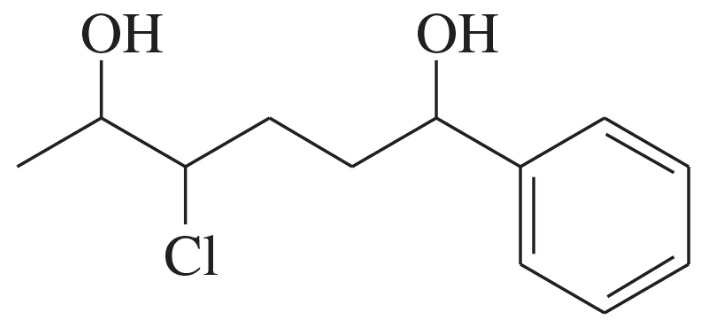
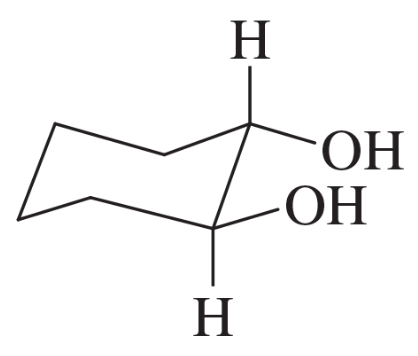
Give systematic (IUPAC) names for the following diols and phenols.
(a) 
(b) 
Verified step by step guidance1
Step 1: Analyze the structure in part (a). The molecule contains a benzene ring attached to a side chain with two hydroxyl (-OH) groups and one chlorine atom. The longest chain containing the hydroxyl groups is a four-carbon chain, and the benzene ring is considered the parent structure.
Step 2: Number the carbon chain in part (a) starting from the carbon attached to the benzene ring to give the hydroxyl groups the lowest possible numbers. The hydroxyl groups are located on carbons 1 and 3, and the chlorine atom is located on carbon 2.
Step 3: Assign the substituents in part (a) their positions and names. The chlorine atom is named as 'chloro,' and the hydroxyl groups are named as 'diol.' Combine these with the parent name 'phenylbutane' to form the systematic name.
Step 4: Analyze the structure in part (b). The molecule is a cyclopentane ring with two hydroxyl (-OH) groups attached to adjacent carbons. The stereochemistry is indicated by the wedge and dash bonds, showing that the hydroxyl groups are cis to each other.
Step 5: Name the structure in part (b) by identifying the parent name 'cyclopentane' and adding the locants and stereochemistry for the hydroxyl groups. Use 'cis' to indicate the relative positions of the hydroxyl groups and 'diol' to indicate the presence of two hydroxyl groups.

Verified video answer for a similar problem:
This video solution was recommended by our tutors as helpful for the problem above.
Video duration:
5mWas this helpful?
Key Concepts
Here are the essential concepts you must grasp in order to answer the question correctly.
IUPAC Nomenclature
The International Union of Pure and Applied Chemistry (IUPAC) nomenclature is a systematic method for naming organic chemical compounds. It provides rules for naming based on the structure of the molecule, including the longest carbon chain, functional groups, and substituents. Understanding these rules is essential for accurately identifying and communicating the identity of organic compounds.
Recommended video:
Guided course
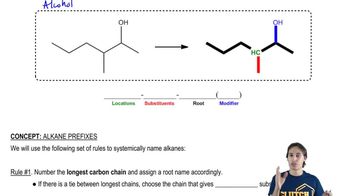
The different parts of an IUPAC name
Diols
Diols, also known as glycols, are organic compounds that contain two hydroxyl (-OH) groups. Their nomenclature involves identifying the longest carbon chain and numbering it to give the hydroxyl groups the lowest possible numbers. The presence of two hydroxyl groups significantly influences the physical and chemical properties of the compound, such as solubility and reactivity.
Recommended video:
Guided course
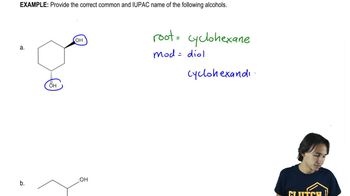
Provide the correct common and IUPAC name.
Phenols
Phenols are a class of organic compounds characterized by a hydroxyl group (-OH) attached to an aromatic hydrocarbon ring. The naming of phenols follows specific IUPAC rules, where the hydroxyl group is prioritized in the naming process. Phenols exhibit unique properties, including acidity and the ability to undergo electrophilic substitution reactions, making them important in both synthetic and natural processes.
Recommended video:
Guided course
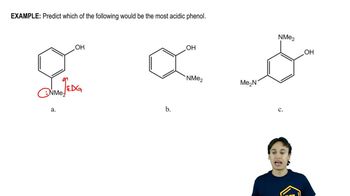
Identify the most acidic phenol
Related Practice
Textbook Question
1
views
Textbook Question
Draw the structures of the following compounds. (Includes both new and old names.)
(a) triphenylmethanol
(b) 4-(chloromethyl)heptan-3-ol
(c) 2-cyclohexen-1-ol
1
views
Textbook Question
Give a systematic (IUPAC) name for each alcohol. Classify each as primary, secondary, or tertiary.
(f)
(g)
1
views
Textbook Question
Give IUPAC names for the following compounds.
1
views
Textbook Question
Draw the structures of the following compounds. (Includes both new and old names.)
i. cyclopent-3-ene-1-thiol
j. dimethyl disulfide
1
views
Textbook Question
Draw the structures of the following compounds. (Includes both new and old names.)
(d) 3-cyclopentylhexan-3-ol
(e) meso-2,4-pentanediol
1
views
