
Authentic skunk spray has become valuable for use in scent-masking products. Show how you would synthesize the major component of skunk spray (3-methylbutane-1-thiol and but-2-ene-1-thiol) from any of the readily available butene or from buta-1,3-diene.
Ch.10 - Structure and Synthesis of Alcohols
Chapter 10, Problem 32a,b,c
Draw the structures of the following compounds. (Includes both new and old names.)
(a) triphenylmethanol
(b) 4-(chloromethyl)heptan-3-ol
(c) 2-cyclohexen-1-ol
Verified step by step guidance1
To draw triphenylmethanol, start by identifying the core structure: a central carbon atom bonded to three phenyl groups (C6H5) and one hydroxyl group (OH). Arrange the phenyl groups around the central carbon in a tetrahedral geometry, and attach the hydroxyl group to the central carbon.
For 4-(chloromethyl)heptan-3-ol, begin by drawing the heptane backbone, which consists of a seven-carbon chain. Number the carbon atoms from one end to the other. At carbon 3, attach a hydroxyl group (OH). At carbon 4, attach a chloromethyl group (CH2Cl).
To draw 2-cyclohexen-1-ol, start with a cyclohexene ring, which is a six-membered carbon ring with one double bond. Place the double bond between carbon 1 and carbon 2. Attach a hydroxyl group (OH) to carbon 1.
Ensure that all hydrogen atoms are added to satisfy the valency of each carbon atom in the structures. For example, each carbon in the phenyl groups of triphenylmethanol should have one hydrogen, except for the central carbon, which is fully substituted.
Double-check the structures for any stereochemistry or geometric isomerism, especially in compounds with double bonds or chiral centers, to ensure the correct spatial arrangement of atoms.

Verified video answer for a similar problem:
This video solution was recommended by our tutors as helpful for the problem above.
Video duration:
5mWas this helpful?
Key Concepts
Here are the essential concepts you must grasp in order to answer the question correctly.
IUPAC Nomenclature
IUPAC nomenclature is a systematic method of naming organic chemical compounds as recommended by the International Union of Pure and Applied Chemistry. It provides a standardized way to name compounds based on their structure, ensuring clarity and consistency. Understanding IUPAC rules is essential for interpreting chemical names and drawing corresponding structures.
Recommended video:
Guided course
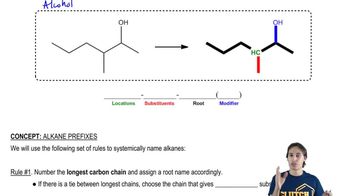
The different parts of an IUPAC name
Functional Groups
Functional groups are specific groups of atoms within molecules that are responsible for the characteristic chemical reactions of those molecules. Recognizing functional groups such as alcohols, alkenes, and halides is crucial for identifying the chemical behavior and structure of organic compounds. In the given question, alcohol (-OH) and halide (Cl) groups are key to drawing the structures.
Recommended video:
Guided course
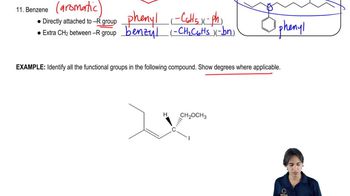
Identifying Functional Groups
Structural Isomerism
Structural isomerism occurs when compounds have the same molecular formula but different structural arrangements of atoms. Understanding structural isomerism is important for accurately drawing organic compounds, as it involves recognizing different possible configurations, such as chain branching or ring formation, which can affect the compound's properties and name.
Recommended video:
Guided course
Monosaccharides - D and L Isomerism
Related Practice
Textbook Question
1
views
Textbook Question
Give systematic (IUPAC) names for the following diols and phenols.
(a)
(b)
8
views
Textbook Question
Draw the structures of the following compounds. (Includes both new and old names.)
(k) 3-methylhex-4-yn-2-ol
1
views
Textbook Question
Give a systematic (IUPAC) name for each alcohol. Classify each as primary, secondary, or tertiary.
(f)
(g)
1
views
Textbook Question
Draw the structures of the following compounds. (Includes both new and old names.)
i. cyclopent-3-ene-1-thiol
j. dimethyl disulfide
1
views
Textbook Question
Draw the structures of the following compounds. (Includes both new and old names.)
(d) 3-cyclopentylhexan-3-ol
(e) meso-2,4-pentanediol
1
views
