Ch.10 - Structure and Synthesis of Alcohols
Wade - Organic Chemistry 9th Edition
Wade9th EditionOrganic ChemistryISBN: 9780135213728Not the one you use?Change textbook
Chapter 10, Problem 32k

Draw the structures of the following compounds. (Includes both new and old names.)
(k) 3-methylhex-4-yn-2-ol

Verified step by step guidance
1
Identify the parent chain: The name '3-methylhex-4-yn-2-ol' indicates that the parent chain is 'hex', which means it has six carbon atoms.
Locate the triple bond: The '4-yn' part of the name indicates a triple bond starting at the fourth carbon atom in the chain.
Identify the functional group: The '2-ol' indicates an alcohol group (-OH) attached to the second carbon atom.
Add the substituent: The '3-methyl' indicates a methyl group (CH₃) attached to the third carbon atom.
Draw the structure: Assemble the structure by placing the triple bond, alcohol group, and methyl group in their respective positions on the hexane chain, ensuring correct connectivity and bond angles.

Verified video answer for a similar problem:

This video solution was recommended by our tutors as helpful for the problem above.
Video duration:
3m
Was this helpful?

Key Concepts

Here are the essential concepts you must grasp in order to answer the question correctly.

IUPAC Nomenclature

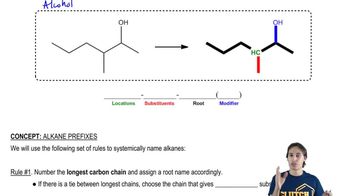
IUPAC nomenclature is a systematic method of naming organic chemical compounds as recommended by the International Union of Pure and Applied Chemistry. It provides a standardized way to describe the structure of a compound using a series of rules, including identifying the longest carbon chain, numbering the chain to give substituents the lowest possible numbers, and naming functional groups and substituents.
Recommended video:
Guided course
03:43
The different parts of an IUPAC name

Functional Groups

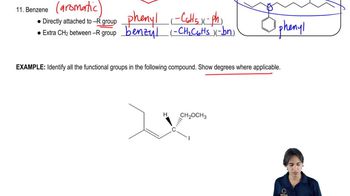
Functional groups are specific groups of atoms within molecules that are responsible for the characteristic chemical reactions of those molecules. In the compound 3-methylhex-4-yn-2-ol, the functional groups include an alcohol (-OH) at the second carbon and an alkyne (triple bond) at the fourth carbon, which influence the compound's reactivity and properties.
Recommended video:
Guided course
02:36
Identifying Functional Groups

Structural Isomers

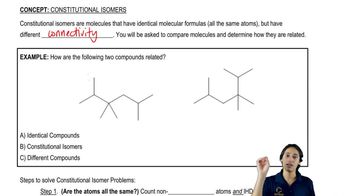
Structural isomers are compounds with the same molecular formula but different structural arrangements of atoms. Understanding structural isomers is crucial for drawing the correct structure of a compound, as the position of substituents like the methyl group in 3-methylhex-4-yn-2-ol can change the compound's properties and name, despite having the same formula.
Recommended video:
Guided course
01:10
What is a constitutional isomer?