Ch. 9 - Substitution and Elimination Reactions of Alkyl Halides
Bruice - Organic Chemistry 8th Edition
Bruice8th EditionOrganic ChemistryISBN: 9780135213711Not the one you use?Change textbook
Chapter 10, Problem 120b

Give two sets of reactants (each set including an alkyl halide and a nucleophile) that could be used to synthesize the following alkyne:
CH3CH2C≡CCH2CH2CH2CH3

Verified step by step guidance
1
Step 1: Recognize that the target molecule is an alkyne with a terminal triple bond. This suggests that the synthesis will involve a nucleophilic substitution reaction where a nucleophile attacks an alkyl halide to form the alkyne.
Step 2: Identify the two main fragments of the alkyne. The molecule can be split into two parts: (1) CH3CH2C≡C⁻ (a terminal alkyne anion, which acts as the nucleophile) and (2) CH2CH2CH2CH3 (a butyl group, which can be introduced via an alkyl halide).
Step 3: Propose the first set of reactants. Use CH3CH2C≡C⁻ as the nucleophile and CH3CH2CH2CH2Br (1-bromobutane) as the alkyl halide. The nucleophile will attack the carbon attached to the bromine in the alkyl halide, displacing the bromine and forming the desired alkyne.
Step 4: Propose the second set of reactants. Reverse the roles of the fragments. Use CH3CH2CH2CH2⁻ (a butyl anion, which can be generated from a butyl nucleophile) and CH3CH2C≡CBr (1-bromo-1-propyne) as the alkyl halide. The butyl nucleophile will attack the carbon attached to the bromine in the alkyl halide, forming the desired alkyne.
Step 5: Ensure that the reaction conditions are suitable for an SN2 mechanism. Use a strong base (e.g., NaNH2) to generate the nucleophile and a polar aprotic solvent (e.g., DMSO) to facilitate the substitution reaction.

Verified video answer for a similar problem:

This video solution was recommended by our tutors as helpful for the problem above.
Video duration:
6m
Was this helpful?

Key Concepts

Here are the essential concepts you must grasp in order to answer the question correctly.

Alkyl Halides

Alkyl halides are organic compounds containing a carbon atom bonded to a halogen atom (such as chlorine, bromine, or iodine). They serve as important reactants in organic synthesis, particularly in nucleophilic substitution reactions. The reactivity of alkyl halides depends on the structure (primary, secondary, or tertiary) and the type of halogen present, influencing the choice of nucleophile and reaction conditions.
Recommended video:
Guided course
01:52
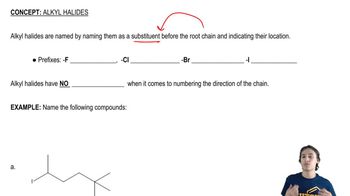
How to name alkyl halides

Nucleophiles

Nucleophiles are species that donate an electron pair to form a chemical bond in a reaction. They are typically negatively charged or neutral molecules with lone pairs of electrons. In the context of synthesizing alkynes, strong nucleophiles can attack the electrophilic carbon in alkyl halides, facilitating the formation of carbon-carbon bonds necessary for constructing the alkyne structure.
Recommended video:
Guided course
08:27
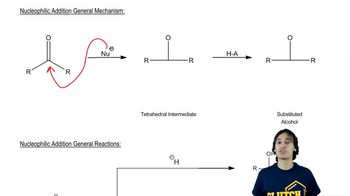
Nucleophilic Addition

Alkyne Synthesis

Alkyne synthesis often involves the formation of carbon-carbon triple bonds through various methods, including elimination reactions or nucleophilic substitutions. One common approach is to use two alkyl halides in a reaction with a strong nucleophile, such as an acetylide ion, to create the desired alkyne. Understanding the mechanisms and conditions for these reactions is crucial for successfully synthesizing specific alkynes.
Recommended video:
Guided course
09:11
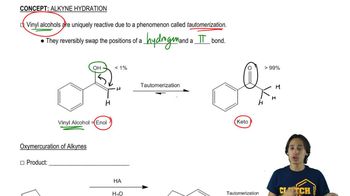
Alkyne Hydration