Give two sets of reactants (each set including an alkyl halide and a nucleophile) that could be used to synthesize the following ether:
Ch. 9 - Substitution and Elimination Reactions of Alkyl Halides
All textbooks
Bruice 8th Edition
Ch. 9 - Substitution and Elimination Reactions of Alkyl Halides
Problem 120a(2)
Bruice 8th Edition
Ch. 9 - Substitution and Elimination Reactions of Alkyl Halides
Problem 120a(2)Chapter 10, Problem 120a(2)
Draw the product of each of the following reactions:
2. 
Verified step by step guidance1
Step 1: Recognize the type of reaction. This is a substitution reaction where the hydroxyl group (-OH) in CH3CH2CH2OH (1-propanol) is replaced by a bromine atom (Br). The reaction involves two steps: deprotonation and substitution.
Step 2: In the first step, NaH (sodium hydride) acts as a strong base. It reacts with the hydroxyl group (-OH) of CH3CH2CH2OH to form an alkoxide ion (CH3CH2CH2O⁻) and hydrogen gas (H2). Write the reaction as: CH3CH2CH2OH + NaH → CH3CH2CH2O⁻ + H2.
Step 3: In the second step, the alkoxide ion (CH3CH2CH2O⁻) reacts with CH3Br (methyl bromide) in an SN2 reaction. The nucleophilic alkoxide ion attacks the carbon atom in CH3Br, displacing the bromide ion (Br⁻) and forming the product CH3CH2CH2OCH3 (propyl methyl ether).
Step 4: Draw the structure of the product. The product is an ether with the structure CH3CH2CH2OCH3, where the oxygen atom is bonded to a propyl group (CH3CH2CH2-) and a methyl group (CH3-).
Step 5: Verify the reaction mechanism and product. Ensure that the reaction follows the expected SN2 mechanism, where the nucleophile (alkoxide ion) attacks the electrophilic carbon in CH3Br, leading to the substitution product.

Verified video answer for a similar problem:
This video solution was recommended by our tutors as helpful for the problem above.
Video duration:
2mWas this helpful?
Key Concepts
Here are the essential concepts you must grasp in order to answer the question correctly.
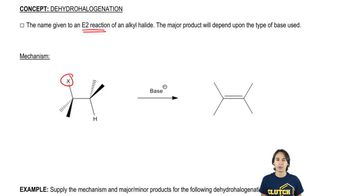
Dehydrohalogenation
Dehydrohalogenation is a chemical reaction that involves the elimination of a hydrogen halide from an alkyl halide, often leading to the formation of alkenes. In the context of the given reaction, sodium hydride (NaH) acts as a strong base, facilitating the removal of a proton from the alcohol (CH3CH2CH2OH) and generating an alkoxide intermediate, which can then react further.
Recommended video:
Guided course
The dehydrohalogenation mechanism.
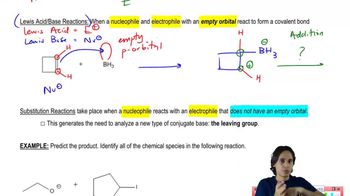
Nucleophilic Substitution
Nucleophilic substitution is a fundamental reaction in organic chemistry where a nucleophile replaces a leaving group in a molecule. In this case, the alkoxide formed from the alcohol can act as a nucleophile, attacking the electrophilic carbon in methyl bromide (CH3Br) to produce an ether or an alkane, depending on the reaction conditions and stoichiometry.
Recommended video:
Guided course
Nucleophiles and Electrophiles can react in Substitution Reactions.
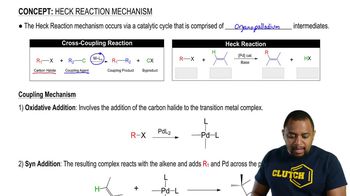
Reaction Mechanism
Understanding the reaction mechanism is crucial for predicting the products of organic reactions. The mechanism outlines the step-by-step process of how reactants transform into products, including the formation of intermediates and the breaking and forming of bonds. In this scenario, recognizing the sequence of deprotonation and nucleophilic attack will help in accurately drawing the final product of the reaction.
Recommended video:
Guided course
Heck Reaction Mechanism
Related Practice
Textbook Question
4
views
Textbook Question
Draw the product of each of the following reactions:
1.
2
views
Textbook Question
cis-4-Bromocyclohexanol and trans-4-bromocyclohexanol form the same elimination product but a different substitution product when they react with HO−.
b. Explain, by showing the mechanisms, why different substitution products are obtained.
1
views
Textbook Question
Propose a mechanism for the following reaction:
1
views
Textbook Question
Give two sets of reactants (each set including an alkyl halide and a nucleophile) that could be used to synthesize the following alkyne:
CH3CH2C≡CCH2CH2CH2CH3
2
views
Textbook Question
cis-4-Bromocyclohexanol and trans-4-bromocyclohexanol form the same elimination product but a different substitution product when they react with HO−.
c. How many stereoisomers does each of the elimination and substitution reactions form?
5
views