Ch. 9 - Substitution and Elimination Reactions of Alkyl Halides
Bruice - Organic Chemistry 8th Edition
Bruice8th EditionOrganic ChemistryISBN: 9780135213711Not the one you use?Change textbook
Chapter 10, Problem 119c

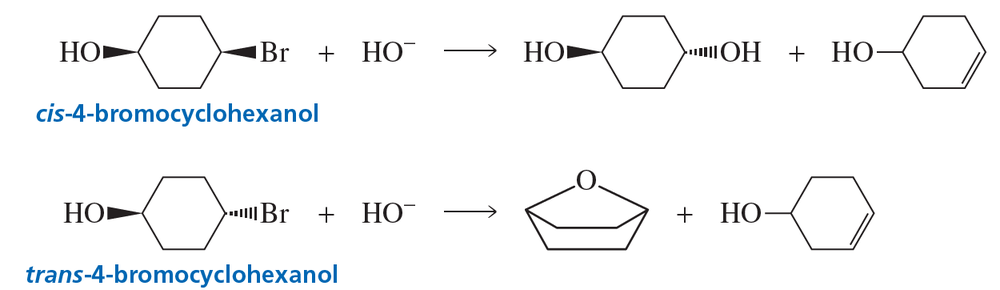
cis-4-Bromocyclohexanol and trans-4-bromocyclohexanol form the same elimination product but a different substitution product when they react with HO.
Chemical reactions of cis-4-bromocyclohexanol and trans-4-bromocyclohexanol with hydroxide ions.
c. How many stereoisomers does each of the elimination and substitution reactions form?

Verified step by step guidance
1
Step 1: Analyze the elimination reaction. In an elimination reaction, the hydroxide ion (HO⁻) acts as a base and removes a proton from a β-carbon, leading to the formation of a double bond. Both cis-4-bromocyclohexanol and trans-4-bromocyclohexanol undergo elimination to form the same alkene product because the stereochemistry of the starting material does not affect the planar nature of the double bond formed.
Step 2: Determine the stereoisomers formed in the elimination reaction. Since the elimination product is an alkene, check for the possibility of cis/trans (E/Z) isomerism in the double bond. If the double bond is formed in a way that allows for stereoisomerism, count the possible configurations.
Step 3: Analyze the substitution reaction. In a substitution reaction, the hydroxide ion (HO⁻) acts as a nucleophile and replaces the bromine atom. The stereochemistry of the starting material affects the stereochemistry of the substitution product, leading to different stereoisomers for cis-4-bromocyclohexanol and trans-4-bromocyclohexanol.
Step 4: Determine the stereoisomers formed in the substitution reaction. For each starting material, consider the stereochemical outcome of the nucleophilic substitution (SN2 mechanism). The inversion of configuration at the carbon bearing the bromine atom will lead to different stereoisomers.
Step 5: Summarize the stereoisomers. Count the total number of stereoisomers formed in both the elimination and substitution reactions for cis-4-bromocyclohexanol and trans-4-bromocyclohexanol, considering the stereochemical differences in the substitution products and the potential stereoisomerism in the elimination product.

Verified video answer for a similar problem:

This video solution was recommended by our tutors as helpful for the problem above.
Video duration:
7m
Was this helpful?

Key Concepts

Here are the essential concepts you must grasp in order to answer the question correctly.

Stereoisomerism

Stereoisomerism refers to the phenomenon where compounds have the same molecular formula and connectivity of atoms but differ in the spatial arrangement of their atoms. This can lead to different physical and chemical properties. In the context of the question, cis and trans isomers of 4-bromocyclohexanol exhibit stereoisomerism, affecting the products formed during elimination and substitution reactions.
Recommended video:
Guided course
01:58
Determining when molecules are stereoisomers.

Elimination vs. Substitution Reactions

Elimination reactions involve the removal of atoms or groups from a molecule, resulting in the formation of a double bond or a ring structure. In contrast, substitution reactions involve replacing one atom or group in a molecule with another. Understanding these mechanisms is crucial for predicting the products formed from cis- and trans-4-bromocyclohexanol when reacted with HO−.
Recommended video:
Guided course
00:38
Intro to Substitution/Elimination Problems

Regioselectivity and Stereoselectivity

Regioselectivity refers to the preference of a chemical reaction to occur at one site over another in a molecule, while stereoselectivity indicates the preference for forming one stereoisomer over another. In the reactions of cis- and trans-4-bromocyclohexanol, the different spatial arrangements lead to distinct regio- and stereoselective outcomes, influencing the number of stereoisomers produced in both elimination and substitution reactions.
Recommended video:
Guided course
05:09
Heck Reaction