
The reaction of an alkyl chloride with potassium iodide is generally carried out in acetone to maximize the amount of alkyl iodide that is formed. Why does the solvent increase the yield of alkyl iodide? (Hint: Potassium iodide is soluble in acetone, but potassium chloride is not.)
Ch. 9 - Substitution and Elimination Reactions of Alkyl Halides
All textbooks
Bruice 8th Edition
Ch. 9 - Substitution and Elimination Reactions of Alkyl Halides
Problem 122
Bruice 8th Edition
Ch. 9 - Substitution and Elimination Reactions of Alkyl Halides
Problem 122Chapter 10, Problem 122
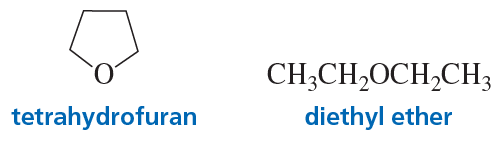
Explain why tetrahydrofuran can solvate a positively charged species better than diethyl ether can.

Verified step by step guidance1
Tetrahydrofuran (THF) is a cyclic ether with a five-membered ring containing an oxygen atom. Diethyl ether, on the other hand, is an acyclic ether with two ethyl groups attached to the oxygen atom. The structural difference plays a key role in their ability to solvate positively charged species.
The oxygen atom in THF is part of a ring structure, which makes it more accessible for interaction with positively charged species. In diethyl ether, the oxygen atom is surrounded by bulky ethyl groups, which can hinder its ability to interact with cations.
THF has a higher dipole moment compared to diethyl ether due to its cyclic structure. A higher dipole moment means that THF can create stronger dipole-dipole interactions with positively charged species, enhancing its solvating ability.
The cyclic nature of THF also allows for a more rigid and organized solvation shell around the positively charged species. This structural advantage improves the stabilization of the cation compared to the more flexible and less organized solvation shell formed by diethyl ether.
In summary, THF's cyclic structure, higher dipole moment, and accessibility of the oxygen atom make it a better solvent for positively charged species compared to diethyl ether.

Verified video answer for a similar problem:
This video solution was recommended by our tutors as helpful for the problem above.
Video duration:
1mWas this helpful?
Key Concepts
Here are the essential concepts you must grasp in order to answer the question correctly.
Polarity and Solvation
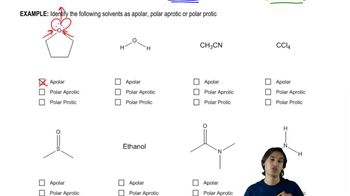
Polarity refers to the distribution of electrical charge over the atoms in a molecule. Tetrahydrofuran (THF) is a polar aprotic solvent, which means it can stabilize charged species through dipole interactions. This ability to solvate positively charged species is crucial in reactions like SN1, where the stability of the carbocation intermediate is enhanced by solvation.
Recommended video:
Guided course
Molecular Polarity
Structure of Solvents
The molecular structure of a solvent affects its solvation capabilities. Tetrahydrofuran has a five-membered ring with an oxygen atom, allowing for a more effective interaction with cations due to its ring strain and polar nature. In contrast, diethyl ether has a linear structure that limits its ability to interact with charged species, making it less effective in solvation.
Recommended video:
Guided course
Identification of polarity in solvents
Dielectric Constant
The dielectric constant is a measure of a solvent's ability to reduce the electrostatic forces between charged particles. Tetrahydrofuran has a higher dielectric constant compared to diethyl ether, which means it can better stabilize ions in solution. This property is essential for facilitating reactions involving charged intermediates, such as those seen in SN1 mechanisms.
Recommended video:
Guided course
The relationship between equilibrium constant and pKa.
Related Practice
Textbook Question
2
views
Textbook Question
What products are formed when the following stereoisomer of 2-chloro-1,3-dimethylcyclohexane reacts with methoxide ion?
2
views
Textbook Question
Propose a mechanism for the following reaction.
1
views
Textbook Question
Give two sets of reactants (each set including an alkyl halide and a nucleophile) that could be used to synthesize the following ether:
4
views
Textbook Question
Propose a mechanism for the following reaction:
1
views
Textbook Question
Give two sets of reactants (each set including an alkyl halide and a nucleophile) that could be used to synthesize the following alkyne:
CH3CH2C≡CCH2CH2CH2CH3
2
views