Ch. 17 - Reactions of Aromatic Compounds
Wade - Organic Chemistry 9th Edition
Wade9th EditionOrganic ChemistryISBN: 9780135213728Not the one you use?Change textbook
Chapter 17, Problem 19b

Show how you would synthesize the following aromatic derivatives from benzene.
b. p-toluenesulfonic acid

Verified step by step guidance
1
Step 1: Begin with benzene (C₆H₆) as the starting material. The goal is to introduce a methyl group (CH₃) and a sulfonic acid group (SO₃H) in the para position relative to each other.
Step 2: Perform a Friedel-Crafts alkylation reaction to introduce the methyl group. React benzene with methyl chloride (CH₃Cl) in the presence of a Lewis acid catalyst, such as aluminum chloride (AlCl₃). This will yield toluene (methylbenzene).
Step 3: Next, perform a sulfonation reaction on toluene. React toluene with concentrated sulfuric acid (H₂SO₄) or fuming sulfuric acid (H₂SO₄ with SO₃). This introduces the sulfonic acid group (SO₃H) onto the aromatic ring.
Step 4: Ensure that the sulfonation occurs at the para position relative to the methyl group. The methyl group is an electron-donating group, which activates the aromatic ring and directs electrophilic substitution to the ortho and para positions. The para product is favored due to steric hindrance at the ortho positions.
Step 5: Isolate and purify the p-toluenesulfonic acid product. This can be done using techniques such as recrystallization or other purification methods to separate it from any minor ortho isomer or unreacted starting materials.

Verified video answer for a similar problem:

This video solution was recommended by our tutors as helpful for the problem above.
Video duration:
3m
Was this helpful?

Key Concepts

Here are the essential concepts you must grasp in order to answer the question correctly.

Electrophilic Aromatic Substitution (EAS)

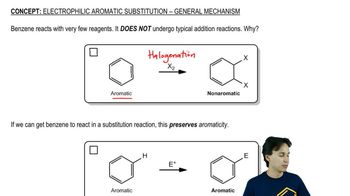
Electrophilic Aromatic Substitution is a fundamental reaction in organic chemistry where an electrophile replaces a hydrogen atom on an aromatic ring. This process is crucial for synthesizing various aromatic derivatives, as it allows for the introduction of different functional groups onto the benzene ring. Understanding the mechanism of EAS, including the role of the electrophile and the stability of the intermediate carbocation, is essential for predicting the products of such reactions.
Recommended video:

Sulfonation

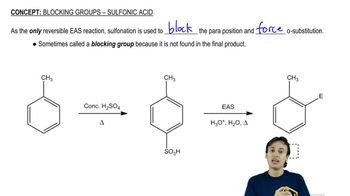
Sulfonation is a specific type of electrophilic aromatic substitution where a sulfonyl group (–SO3H) is introduced into an aromatic compound. In the case of synthesizing p-toluenesulfonic acid from benzene, sulfur trioxide (SO3) or a sulfonating agent like fuming sulfuric acid is used. This reaction typically occurs at the para position relative to existing substituents due to steric and electronic effects, making it a key step in the synthesis of sulfonic acids.
Recommended video:
Guided course
04:33
Forcing Ortho substitution

Reactivity of Aromatic Compounds

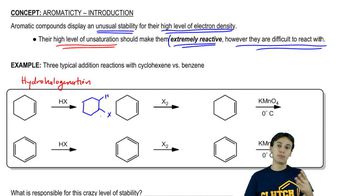
The reactivity of aromatic compounds is influenced by the presence of substituents on the benzene ring, which can either activate or deactivate the ring towards electrophilic substitution. Electron-donating groups, such as methyl (–CH3) in toluene, increase the electron density of the ring, making it more reactive towards electrophiles. Conversely, electron-withdrawing groups decrease reactivity. Understanding these effects is vital for predicting the outcome of reactions and the positions where new substituents will be added.
Recommended video:
Guided course
08:19
Intro to Aromaticity