Ch. 17 - Reactions of Aromatic Compounds
Wade - Organic Chemistry 9th Edition
Wade9th EditionOrganic ChemistryISBN: 9780135213728Not the one you use?Change textbook
Chapter 17, Problem 18e

Which reactions will produce the desired product in good yield? You may assume that aluminum chloride is added as a catalyst in each case. For the reactions that will not give a good yield of the desired product, predict the major products.
(e) Reagents: toluene + HNO3, H2SO4, heat
Desired Product: 2,4,6-trinitrotoluene (TNT)

Verified step by step guidance
1
Step 1: Analyze the reaction conditions. The image shows a nitrobenzene reacting with tert-butyl chloride in the presence of a catalyst, likely aluminum chloride (AlCl₃). This suggests a Friedel-Crafts alkylation reaction.
Step 2: Understand the mechanism of Friedel-Crafts alkylation. The tert-butyl chloride reacts with AlCl₃ to form a highly reactive tert-butyl carbocation, which serves as the electrophile in the reaction.
Step 3: Predict the regioselectivity of the reaction. The nitro group (-NO₂) on the benzene ring is an electron-withdrawing group, which deactivates the ring and directs electrophilic substitution to the meta position relative to itself.
Step 4: Determine the major product. The tert-butyl carbocation will attack the meta position of the nitrobenzene, resulting in the formation of the product shown in the image: 1-nitro-3-tert-butylbenzene.
Step 5: Verify the reaction feasibility. Friedel-Crafts alkylation is generally not efficient on strongly deactivated rings like nitrobenzene. However, under specific conditions, the reaction may proceed to give the desired product in moderate yield.

Verified video answer for a similar problem:

This video solution was recommended by our tutors as helpful for the problem above.
Video duration:
5m
Was this helpful?

Key Concepts

Here are the essential concepts you must grasp in order to answer the question correctly.

Electrophilic Aromatic Substitution (EAS)

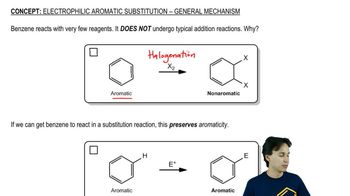
Electrophilic Aromatic Substitution is a fundamental reaction in organic chemistry where an electrophile replaces a hydrogen atom on an aromatic ring. In the context of the question, toluene undergoes EAS when treated with a mixture of nitric acid and sulfuric acid, generating nitronium ions (NO2+) that act as the electrophile. The position of substitution is influenced by the electron-donating properties of the methyl group in toluene.
Recommended video:

Regioselectivity in Aromatic Reactions

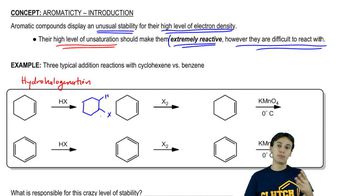
Regioselectivity refers to the preference of a chemical reaction to yield one structural isomer over others. In the case of toluene nitration, the methyl group directs the incoming nitro group to the ortho and para positions due to its electron-donating effect, leading to the formation of 2,4,6-trinitrotoluene (TNT) as the desired product. Understanding regioselectivity is crucial for predicting the major products of aromatic substitution reactions.
Recommended video:
Guided course
08:19
Intro to Aromaticity

Catalysis and Reaction Conditions

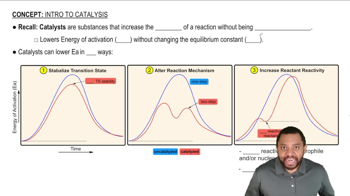
Catalysis involves the use of a substance to increase the rate of a chemical reaction without being consumed in the process. In this scenario, aluminum chloride acts as a catalyst, enhancing the electrophilic substitution reaction. The reaction conditions, including temperature and the presence of strong acids, are vital for achieving a good yield of the desired product, as they influence the reactivity of the electrophile and the stability of intermediates formed during the reaction.
Recommended video:
2:10
Introduction to Catalysis Concept 1