Ch. 17 - Reactions of Aromatic Compounds
Wade - Organic Chemistry 9th Edition
Wade9th EditionOrganic ChemistryISBN: 9780135213728Not the one you use?Change textbook
Chapter 17, Problem 20b

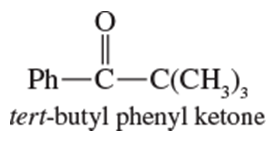
Show how you would use the Friedel–Crafts acylation, Clemmensen reduction, and/or Gatterman–Koch synthesis to prepare the following compounds:
b.

Verified step by step guidance
1
Step 1: Begin with Friedel–Crafts acylation to introduce a ketone group onto the benzene ring. Use benzene as the starting material and react it with pivaloyl chloride (tert-butyl carbonyl chloride, (CH3)3CCl) in the presence of a Lewis acid catalyst such as AlCl3. This will yield tert-butyl phenyl ketone (Ph-C(O)-C(CH3)3).
Step 2: Perform a Clemmensen reduction to convert the ketone group into a methylene group. React the tert-butyl phenyl ketone with zinc amalgam (Zn(Hg)) and concentrated hydrochloric acid (HCl). This will reduce the carbonyl group to a CH2 group, resulting in tert-butylbenzene (Ph-CH2-C(CH3)3).
Step 3: To introduce the cyclopropyl group, perform a reaction that substitutes the tert-butyl group with a cyclopropyl group. This can be achieved using a suitable alkylation method, such as reacting tert-butylbenzene with cyclopropyl bromide in the presence of a base like NaH or KOH.
Step 4: Ensure the final product matches the target compound structure, which is benzylcyclopropane. Verify that the benzene ring is intact and the cyclopropyl group is attached to the benzyl position.
Step 5: Review the reaction conditions and intermediates to confirm that the synthesis pathway is efficient and avoids side reactions. Adjust reagents or conditions if necessary to optimize the yield of the desired compound.

Verified video answer for a similar problem:

This video solution was recommended by our tutors as helpful for the problem above.
Video duration:
4m
Was this helpful?

Key Concepts

Here are the essential concepts you must grasp in order to answer the question correctly.

Friedel–Crafts Acylation

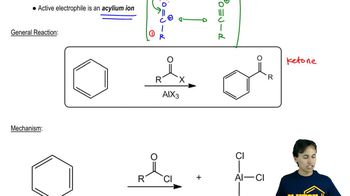
Friedel–Crafts acylation is an electrophilic aromatic substitution reaction that introduces an acyl group into an aromatic ring. This reaction typically uses an acyl chloride and a Lewis acid catalyst, such as AlCl3, to form a ketone. It is particularly useful for synthesizing aromatic ketones, making it relevant for preparing compounds like tert-butyl phenyl ketone.
Recommended video:
Guided course
05:20
Friedel-Crafts Acylation

Clemmensen Reduction

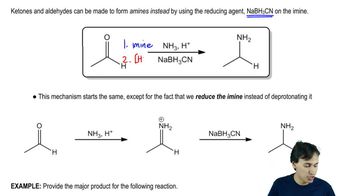
The Clemmensen reduction is a chemical reaction that reduces carbonyl groups (ketones or aldehydes) to alkanes using zinc amalgam and hydrochloric acid. This reaction is significant in organic synthesis for converting ketones into their corresponding alkanes, which can be useful in various synthetic pathways, including the modification of aromatic compounds.
Recommended video:
Guided course
07:12
Reductive Amination

Gatterman–Koch Synthesis

The Gatterman–Koch synthesis is a method for synthesizing aromatic aldehydes from aromatic compounds using carbon monoxide and hydrochloric acid in the presence of a Lewis acid catalyst. This reaction is important for introducing functional groups into aromatic systems, which can then be further transformed into ketones or other derivatives, aiding in the preparation of complex organic molecules.
Recommended video:
1:16
Synthesis of Amino Acids: Strecker Synthesis Example 1