
Textbook Question
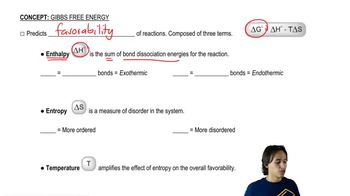
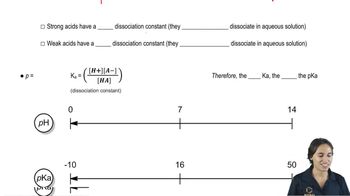
The following reaction has a value of ΔG° = –2.1 kJ/mol (–0.50 kcal/mol).
CH3Br + H2S ⇌ CH3SH + HBr
b. Starting with a 1 M solution of CH3Br and H2S, calculate the final concentrations of all four species at equilibrium.
2
views


 Verified step by step guidance
 05:02
05:02
 02:19
02:19 01:57
01:57The following reaction has a value of ΔG° = –2.1 kJ/mol (–0.50 kcal/mol).
CH3Br + H2S ⇌ CH3SH + HBr
b. Starting with a 1 M solution of CH3Br and H2S, calculate the final concentrations of all four species at equilibrium.
When ethene is mixed with hydrogen in the presence of a platinum catalyst, hydrogen adds across the double bond to form ethane. At room temperature, the reaction goes to completion. Predict the signs of ΔH° and ΔS° for this reaction. Explain these signs in terms of bonding and freedom of motion.
Free-radical chlorination of hexane gives very poor yields of 1-chlorohexane, while cyclohexane can be converted to chlorocyclohexane in good yield.
a. How do you account for this difference?
b. What ratio of reactants (cyclohexane and chlorine) would you use for the synthesis of chlorocyclohexane?
Draw a reaction-energy diagram for the propagation steps of the free-radical addition of HBr to isobutylene. Draw curves representing the reactions leading to both the Markovnikov and the anti-Markovnikov products. Compare the values of ∆Gº and Ea and for the rate-limiting steps, and explain why only one of these products is observed.
The following reaction has a value of ΔG° = –2.1 kJ/mol (–0.50 kcal/mol).
CH3Br + H2S ⇌ CH3SH + HBr
a. Calculate Keq at room temperature (25 °C) for this reaction as written.