Ch.4 - The Study of Chemical Reactions
Wade - Organic Chemistry 9th Edition
Wade9th EditionOrganic ChemistryISBN: 9780135213728Not the one you use?Change textbook
Chapter 4, Problem 5a

The following reaction has a value of ΔG° = –2.1 kJ/mol (–0.50 kcal/mol).
CH3Br + H2S ⇌ CH3SH + HBr
a. Calculate Keq at room temperature (25 °C) for this reaction as written.

Verified step by step guidance
1
Understand the relationship between ΔG (Gibbs free energy change) and the equilibrium constant (Keq). The equation to use is ΔG = -RT ln(Keq), where R is the gas constant and T is the temperature in Kelvin.
Convert the temperature from Celsius to Kelvin. Use the formula T(K) = T(°C) + 273.15. For 25 °C, T = 25 + 273.15 = 298.15 K.
Identify the value of the gas constant R. For this calculation, use R = 8.314 J/(mol·K) (note that ΔG is given in kJ/mol, so ensure consistent units).
Rearrange the equation ΔG = -RT ln(Keq) to solve for Keq. The rearranged formula is Keq = e^(-ΔG / RT).
Substitute the given values into the equation: ΔG = -2.1 kJ/mol (convert to J/mol by multiplying by 1000), R = 8.314 J/(mol·K), and T = 298.15 K. Perform the calculation to find Keq.

Verified video answer for a similar problem:

This video solution was recommended by our tutors as helpful for the problem above.
Video duration:
3m
Was this helpful?

Key Concepts

Here are the essential concepts you must grasp in order to answer the question correctly.

Gibbs Free Energy (ΔG)

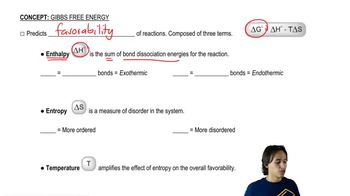
Gibbs Free Energy (ΔG) is a thermodynamic potential that measures the maximum reversible work obtainable from a thermodynamic system at constant temperature and pressure. A negative ΔG indicates that a reaction is spontaneous, meaning it can proceed without external energy input. The magnitude of ΔG also provides insight into the reaction's favorability and equilibrium position.
Recommended video:
Guided course
05:02
Breaking down the different terms of the Gibbs Free Energy equation.

Equilibrium Constant (Keq)

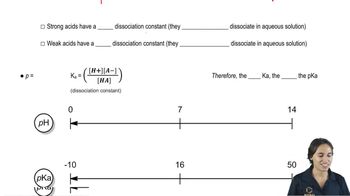
The equilibrium constant (Keq) is a dimensionless value that expresses the ratio of the concentrations of products to reactants at equilibrium for a given reaction at a specific temperature. It is derived from the law of mass action and provides insight into the extent of a reaction; a larger Keq indicates a greater concentration of products at equilibrium, while a smaller Keq suggests more reactants.
Recommended video:
Guided course
02:19
The relationship between equilibrium constant and pKa.

Relationship between ΔG and Keq

The relationship between Gibbs Free Energy (ΔG) and the equilibrium constant (Keq) is described by the equation ΔG = -RT ln(Keq), where R is the universal gas constant and T is the temperature in Kelvin. This equation allows for the calculation of Keq from ΔG values, indicating how the spontaneity of a reaction correlates with its equilibrium position. A negative ΔG corresponds to a Keq greater than 1, suggesting that products are favored at equilibrium.
Recommended video:
Guided course
01:40
Same atoms, same connectivity, 1 chiral center.
Related Practice
Textbook Question

The following reaction has a value of ΔG° = –2.1 kJ/mol (–0.50 kcal/mol).

CH3Br + H2S ⇌ CH3SH + HBr

b. Starting with a 1 M solution of CH3Br and H2S, calculate the final concentrations of all four species at equilibrium.

2
views

Textbook Question

Use the bond-dissociation enthalpies in Table 4-2 (page 167) to calculate the heats of reaction for the two possible first propagation steps in the chlorination of isobutane. Use this information to draw a reaction-energy diagram like Figure 4-8, comparing the activation energies for formation of the two radicals.

2
views
Textbook Question

Under base-catalyzed conditions, two molecules of acetone can condense to form diacetone alcohol. At room temperature (25 °C), about 5% of the acetone is converted to diacetone alcohol. Determine the value of ΔG° for this reaction.

1
views
Textbook Question

Free-radical chlorination of hexane gives very poor yields of 1-chlorohexane, while cyclohexane can be converted to chlorocyclohexane in good yield.

a. How do you account for this difference?

b. What ratio of reactants (cyclohexane and chlorine) would you use for the synthesis of chlorocyclohexane?

3
views
Textbook Question
The reaction of tert-butyl chloride with methanol(CH3)3C—Cl Tert-butylchloride + CH3—OH methanol —> (CH3)C—OCH3 methyltert-butylether + HCl is found to follow the rate equation rate= Kr[(CH3)3C—Cl] c. What is the kinetic order overall?
2
views
Textbook Question
The dehydrogenation of butane to trans-but-2-ene has ΔH° = +116 kJ/mol (+27.6 kcal/mol) and ΔS° = +117J/kelvin-mol (+28.0 cal/kelvin-mol). a. Compute the value of ΔG° for dehydrogenation at room temperature (25 °C or 298 °K). Is dehydrogenation favored or disfavored?HINT: When you are doing synthesis problems, avoid using these high-temperature industrial methods. They require specialized equipment, and they produce variable mixtures of products.