
When ethene is mixed with hydrogen in the presence of a platinum catalyst, hydrogen adds across the double bond to form ethane. At room temperature, the reaction goes to completion. Predict the signs of ΔH° and ΔS° for this reaction. Explain these signs in terms of bonding and freedom of motion.
Ch.4 - The Study of Chemical Reactions
Chapter 4, Problem 8.59
Draw a reaction-energy diagram for the propagation steps of the free-radical addition of HBr to isobutylene. Draw curves representing the reactions leading to both the Markovnikov and the anti-Markovnikov products. Compare the values of ∆Gº and Ea and for the rate-limiting steps, and explain why only one of these products is observed.
Verified step by step guidance1
Identify the reactants and products involved in the free-radical addition of HBr to isobutylene. The reactants are isobutylene and HBr, and the products are the Markovnikov and anti-Markovnikov addition products.
Understand the mechanism of free-radical addition. The process involves initiation, propagation, and termination steps. Focus on the propagation steps where the radical intermediates are formed.
Draw the reaction-energy diagram. Start with the energy level of the reactants, then show the energy changes as the reaction proceeds through the formation of radical intermediates to the final products.
For the Markovnikov product, the more stable radical intermediate is formed, leading to a lower activation energy (Ea) and a more negative Gibbs free energy change (∆Gº) for the rate-limiting step.
For the anti-Markovnikov product, the less stable radical intermediate is formed, resulting in a higher activation energy (Ea) and a less favorable Gibbs free energy change (∆Gº). This explains why the Markovnikov product is predominantly observed.

Verified video answer for a similar problem:
This video solution was recommended by our tutors as helpful for the problem above.
Video duration:
6mWas this helpful?
Key Concepts
Here are the essential concepts you must grasp in order to answer the question correctly.
Free Radical Mechanism
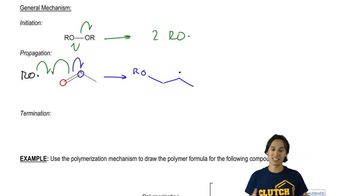
The free radical mechanism involves the formation of reactive species with unpaired electrons, known as free radicals. In the context of the addition of HBr to isobutylene, the reaction proceeds through initiation, propagation, and termination steps. Understanding this mechanism is crucial for analyzing how the radicals interact and lead to different products, specifically the Markovnikov and anti-Markovnikov outcomes.
Recommended video:
Guided course
The mechanism of Radical Polymerization.
Markovnikov's Rule
Markovnikov's Rule states that in the addition of HX to an alkene, the hydrogen atom will attach to the carbon with the greater number of hydrogen atoms, leading to the more stable carbocation intermediate. This principle helps predict the major product in reactions involving unsymmetrical alkenes, such as isobutylene, and is essential for understanding the product distribution in the free radical addition of HBr.
Recommended video:
Guided course
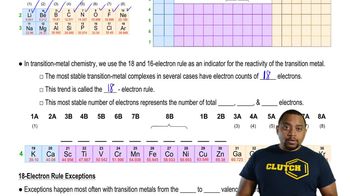
The 18 and 16 Electron Rule
Activation Energy (Ea) and Gibbs Free Energy (∆Gº)
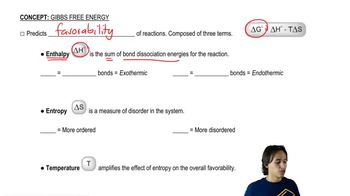
Activation energy (Ea) is the minimum energy required for a reaction to occur, while Gibbs free energy change (∆Gº) indicates the spontaneity of a reaction. In the context of the reaction-energy diagram, comparing the Ea and ∆Gº for the rate-limiting steps of both pathways helps explain why one product is favored over the other. A lower Ea typically correlates with a faster reaction rate, influencing the observed product distribution.
Recommended video:
Guided course
Breaking down the different terms of the Gibbs Free Energy equation.
Related Practice
Textbook Question
2
views
Textbook Question
Under base-catalyzed conditions, two molecules of acetone can condense to form diacetone alcohol. At room temperature (25 °C), about 5% of the acetone is converted to diacetone alcohol. Determine the value of ΔG° for this reaction.
1
views
Textbook Question
For each reaction, estimate whether ΔS° for the reaction is positive, negative, or impossible to predict.
(a)
2
views
Textbook Question
For each reaction, estimate whether ΔS° for the reaction is positive, negative, or impossible to predict.
(c)
2
views
Textbook Question
For each reaction, estimate whether ΔS° for the reaction is positive, negative, or impossible to predict.
(b)
6
views
Textbook Question
The dehydrogenation of butane to trans-but-2-ene has ΔH° = +116 kJ/mol (+27.6 kcal/mol) and ΔS° = +117J/kelvin-mol (+28.0 cal/kelvin-mol). a. Compute the value of ΔG° for dehydrogenation at room temperature (25 °C or 298 °K). Is dehydrogenation favored or disfavored?HINT: When you are doing synthesis problems, avoid using these high-temperature industrial methods. They require specialized equipment, and they produce variable mixtures of products.
