Ch. 11 - Properties and Synthesis of Alkyl Halides: Radical Reactions
Mullins - Organic Chemistry: A Learner Centered Approach 1st Edition
Mullins1st EditionOrganic Chemistry: A Learner Centered ApproachISBN: 9780137566471Not the one you use?Change textbook
Chapter 10, Problem 44

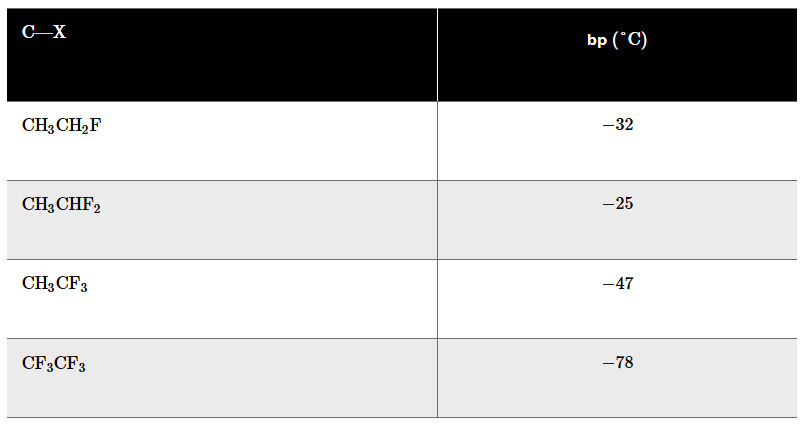
Contrary to expectation, the addition of more fluorines to ethane lowers the boiling point. Explain this phenomenon.

Verified step by step guidance
1
Step 1: Analyze the data provided in the table. The boiling points of fluorinated ethane derivatives decrease as the number of fluorine atoms increases. For example, CH3CH2F has a boiling point of -32°C, while CF3CF3 has a boiling point of -78°C.
Step 2: Understand the concept of boiling point. Boiling point is influenced by intermolecular forces such as dipole-dipole interactions, hydrogen bonding, and London dispersion forces. Stronger intermolecular forces lead to higher boiling points.
Step 3: Consider the effect of fluorine atoms on molecular polarity. Fluorine is highly electronegative, and its addition to ethane increases the molecule's polarity initially. However, as more fluorine atoms are added, the molecule becomes more symmetrical, reducing the net dipole moment.
Step 4: Evaluate the role of London dispersion forces. Fluorine atoms are small and reduce the surface area of the molecule available for London dispersion forces. This diminishes the strength of these forces, contributing to a lower boiling point.
Step 5: Conclude that the decrease in boiling point with increased fluorination is due to the reduction in net dipole moment (symmetry) and weaker London dispersion forces, despite the initial increase in polarity from fluorine's electronegativity.

Verified video answer for a similar problem:

This video solution was recommended by our tutors as helpful for the problem above.
Was this helpful?

Key Concepts

Here are the essential concepts you must grasp in order to answer the question correctly.

Polarity and Intermolecular Forces

Polarity refers to the distribution of electrical charge over the atoms in a molecule. In organic compounds, polar molecules tend to have stronger intermolecular forces, such as dipole-dipole interactions and hydrogen bonding, which can lead to higher boiling points. Ethane is a nonpolar molecule, and the addition of fluorine, which is highly electronegative, can create polar bonds that influence the overall polarity and intermolecular forces.
Recommended video:
Guided course
03:01
How Van der Waals forces work.

Steric Hindrance

Steric hindrance occurs when the spatial arrangement of atoms in a molecule prevents certain interactions, such as bonding or the approach of other molecules. In the case of fluorinated ethane, the bulky fluorine atoms can create steric hindrance, which may disrupt the close packing of molecules and reduce the effectiveness of intermolecular forces, leading to a lower boiling point despite the presence of polar bonds.
Recommended video:
Guided course
02:53
Understanding steric effects.

Fluorine's Influence on Molecular Structure

Fluorine is a small, highly electronegative atom that can significantly alter the properties of organic molecules. When added to ethane, fluorine can change the molecular geometry and electronic distribution, potentially leading to a decrease in the overall boiling point. This is because the strong C-F bonds can create a more rigid structure that does not allow for the same degree of molecular interactions as less electronegative substituents.
Recommended video:
Guided course
08:41
Review of Molecular Orbitals