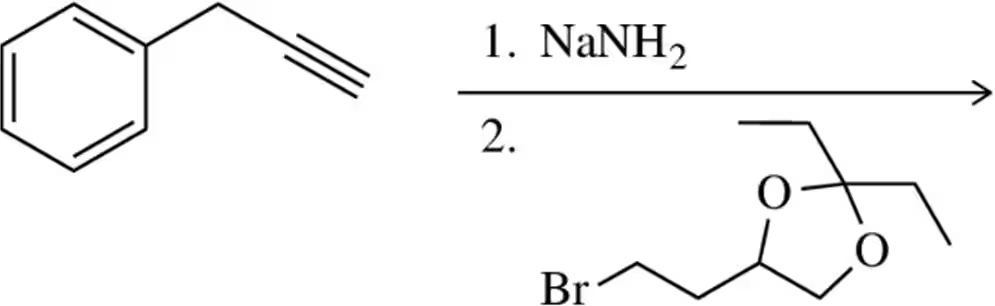
Show the products of the following acetylide alkylation reactions. [Make sure your product has the correct number of carbons.] (a)
Verified step by step guidance
1
Step 1: Understand the concept of acetylide alkylation. Acetylide ions (R-C≡C⁻) are strong nucleophiles that can attack alkyl halides (R-X) in an SN2 reaction, leading to the formation of a new carbon-carbon bond.
Step 2: Identify the acetylide ion and the alkyl halide in the reaction. The acetylide ion is typically generated from a terminal alkyne (R-C≡CH) by deprotonation using a strong base like NaNH₂ or NaH.
Step 3: Write the mechanism of the SN2 reaction. The acetylide ion attacks the carbon atom bonded to the halogen in the alkyl halide, displacing the halide ion (X⁻) and forming a new bond between the acetylide carbon and the alkyl group.
Step 4: Count the number of carbons in the product. Add the number of carbons in the acetylide ion to the number of carbons in the alkyl halide to ensure the product has the correct number of carbons.
Step 5: Draw the structure of the product. Combine the acetylide group (R-C≡C⁻) with the alkyl group from the alkyl halide, ensuring the triple bond remains intact and the connectivity is correct.
Verified video answer for a similar problem:
This video solution was recommended by our tutors as helpful for the problem above
Video duration:
2m
Play a video:
0 Comments
Key Concepts
Here are the essential concepts you must grasp in order to answer the question correctly.
Acetylide Ion
An acetylide ion is a negatively charged species formed by deprotonating a terminal alkyne. It is a strong nucleophile, capable of attacking electrophiles in nucleophilic substitution reactions. Understanding how to generate and utilize acetylide ions is crucial for performing alkylation reactions effectively.
Nucleophilic substitution is a fundamental reaction mechanism in organic chemistry where a nucleophile replaces a leaving group in a molecule. In the context of acetylide alkylation, the acetylide ion acts as the nucleophile, attacking an alkyl halide to form a new carbon-carbon bond. This process is essential for extending carbon chains in organic synthesis.
Nucleophiles and Electrophiles can react in Substitution Reactions.
Carbon Count in Products
Maintaining the correct number of carbons in the product is vital in organic synthesis, as it ensures the integrity of the molecular structure. In acetylide alkylation, the number of carbons in the starting materials and the alkyl halide must be accounted for to predict the final product accurately. This concept is crucial for verifying the success of the reaction and understanding the resulting compound's properties.