Ch. 7 - The Reactions of Alkynes • An Introduction to Multistep Synthesis
Bruice - Organic Chemistry 8th Edition
Bruice8th EditionOrganic ChemistryISBN: 9780135213711Not the one you use?Change textbook
Chapter 8, Problem 39j

What is the major product of the reaction of 1 mol of propyne with each of the following reagents?
j. the product of part i followed by 1-chloropropane

Verified step by step guidance
1
Step 1: Begin by analyzing the reaction in part i. Propyne (CH≡C-CH₃) reacts with the reagent specified in part i. Determine the product formed in part i before proceeding to part j.
Step 2: Once the product of part i is identified, consider the reaction of this product with 1-chloropropane (CH₃-CH₂-CH₂-Cl). This step involves understanding the type of reaction mechanism that will occur, such as nucleophilic substitution or addition.
Step 3: Identify the functional groups present in the product of part i and in 1-chloropropane. Determine how these groups interact chemically, considering factors like electrophilicity, nucleophilicity, and steric hindrance.
Step 4: Predict the major product of the reaction based on the mechanism. For example, if the reaction involves nucleophilic substitution, identify the leaving group and the nucleophile, and predict the structure of the resulting compound.
Step 5: Verify the stability of the major product formed. Consider factors such as resonance stabilization, steric effects, and electronic effects to confirm that the predicted product is indeed the major product of the reaction.

Verified video answer for a similar problem:

This video solution was recommended by our tutors as helpful for the problem above.
Video duration:
5m
Was this helpful?

Key Concepts

Here are the essential concepts you must grasp in order to answer the question correctly.

Alkyne Reactivity

Alkynes, such as propyne, are unsaturated hydrocarbons that contain a carbon-carbon triple bond. This triple bond makes them highly reactive, particularly in addition reactions. Understanding how alkynes react with various reagents is crucial for predicting the products of these reactions, including the formation of alkenes or alkanes depending on the conditions and reagents used.
Recommended video:
Guided course
09:11
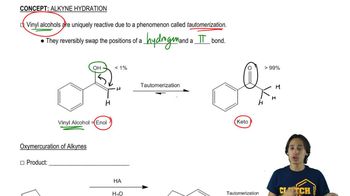
Alkyne Hydration

Nucleophilic Substitution

Nucleophilic substitution is a fundamental reaction mechanism in organic chemistry where a nucleophile replaces a leaving group in a molecule. In the context of the question, 1-chloropropane can act as a nucleophile, and understanding how it interacts with the product from the first reaction is essential for determining the final product. This concept is key in predicting the outcome of reactions involving alkyl halides.
Recommended video:
Guided course
01:47
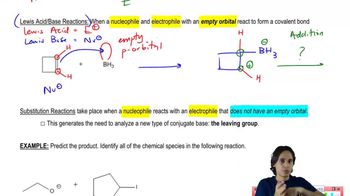
Nucleophiles and Electrophiles can react in Substitution Reactions.

Markovnikov's Rule

Markovnikov's Rule states that in the addition of HX to an alkene or alkyne, the hydrogen atom will attach to the carbon with the greater number of hydrogen atoms already attached. This principle helps predict the regioselectivity of reactions involving propyne and other unsaturated hydrocarbons, guiding the formation of major products when reacting with electrophiles or during nucleophilic substitutions.
Recommended video:
Guided course
03:54
The 18 and 16 Electron Rule