Ch. 7 - The Reactions of Alkynes • An Introduction to Multistep Synthesis
Bruice - Organic Chemistry 8th Edition
Bruice8th EditionOrganic ChemistryISBN: 9780135213711Not the one you use?Change textbook
Chapter 8, Problem 39g,h

What is the major product of the reaction of 1 mol of propyne with each of the following reagents?
g. excess H2, Pd/C
h. H2/Lindlar catalyst

Verified step by step guidance
1
Step 1: Understand the structure of propyne. Propyne is an alkyne with the molecular formula C3H4. It contains a triple bond between the first and second carbon atoms (CH≡C-CH3).
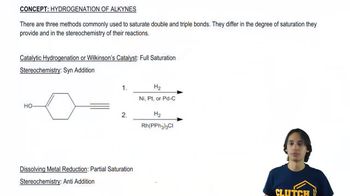
Step 2: Analyze the reaction with excess H2 and Pd/C. In the presence of excess hydrogen gas (H2) and a palladium catalyst (Pd/C), the triple bond in propyne undergoes complete hydrogenation. This means the triple bond is reduced to a single bond, and all π bonds are replaced with σ bonds, resulting in a fully saturated alkane.
Step 3: Predict the product for excess H2 and Pd/C. The major product of this reaction is propane (CH3-CH2-CH3), as the triple bond is completely reduced to a single bond, and hydrogen atoms are added to the carbons involved in the triple bond.
Step 4: Analyze the reaction with H2 and Lindlar catalyst. The Lindlar catalyst is a poisoned catalyst that selectively reduces alkynes to alkenes without further reducing the alkene to an alkane. In this case, the triple bond in propyne is partially hydrogenated to form a cis-alkene.
Step 5: Predict the product for H2 and Lindlar catalyst. The major product of this reaction is cis-propene (CH3-CH=CH2), as the Lindlar catalyst ensures the addition of hydrogen atoms occurs on the same side of the molecule, resulting in a cis configuration.

Verified video answer for a similar problem:

This video solution was recommended by our tutors as helpful for the problem above.
Video duration:
4m
Was this helpful?

Key Concepts

Here are the essential concepts you must grasp in order to answer the question correctly.

Hydrogenation

Hydrogenation is a chemical reaction that involves the addition of hydrogen (H2) to unsaturated hydrocarbons, such as alkenes and alkynes, converting them into saturated hydrocarbons. In the context of propyne, hydrogenation can lead to the formation of propane when excess hydrogen is used, as it fully saturates the triple bond.
Recommended video:
Guided course
00:48
The definition of hydrogenation.

Catalysts

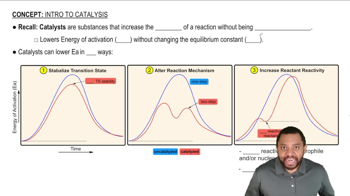
Catalysts are substances that increase the rate of a chemical reaction without being consumed in the process. In the case of propyne reactions, palladium on carbon (Pd/C) is a common catalyst for complete hydrogenation, while Lindlar's catalyst, which is a poisoned palladium catalyst, selectively hydrogenates alkynes to cis-alkenes, preventing further reduction to alkanes.
Recommended video:
2:10
Introduction to Catalysis Concept 1

Alkyne Reactivity

Alkynes, characterized by their carbon-carbon triple bonds, exhibit unique reactivity patterns compared to alkenes and alkanes. They can undergo various reactions, including hydrogenation, where the triple bond can be converted to a double bond or a single bond, depending on the conditions and reagents used, influencing the final product formed in the reaction.
Recommended video:
Guided course
09:11
Alkyne Hydration