Identify each of the following changes of state as melting, freezing, sublimation, or deposition:b. Snow on the ground turns to liquid water.
Verified step by step guidance
1
Identify the initial state of the substance: Snow is in the solid state.
Determine the final state of the substance: Liquid water is in the liquid state.
Recall the process that describes the change from solid to liquid: This process is called melting.
Understand that melting occurs when a solid absorbs heat and changes into a liquid.
Conclude that the change of state from snow to liquid water is an example of melting.
Verified video answer for a similar problem:
This video solution was recommended by our tutors as helpful for the problem above
Video duration:
1m
Play a video:
0 Comments
Key Concepts
Here are the essential concepts you must grasp in order to answer the question correctly.
Melting
Melting is the process where a solid turns into a liquid as it absorbs heat. This occurs when the temperature of the solid reaches its melting point, allowing the particles to gain enough energy to overcome the forces holding them in a fixed position. In the context of the question, melting is relevant as it describes the transition of snow (solid) to water (liquid).
Freezing is the reverse process of melting, where a liquid turns into a solid as it loses heat. This occurs when the temperature of the liquid drops to its freezing point, causing the particles to lose energy and arrange themselves into a fixed structure. While freezing is not the process described in the question, understanding it helps clarify the relationship between solid and liquid states.
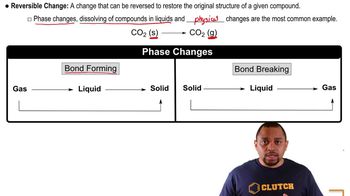
Phase changes refer to the transitions between different states of matter: solid, liquid, and gas. These changes occur due to variations in temperature and pressure, affecting the energy and arrangement of particles. In the question, the change from snow to liquid water exemplifies a phase change, specifically melting, highlighting the dynamic nature of matter.