Show the dipole arrow for each of the following bonds: (6.7)a. Si―Cl
Verified step by step guidance
1
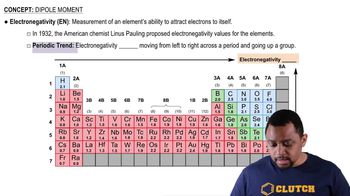
Identify the electronegativity of each atom in the bond. Silicon (Si) has an electronegativity of about 1.90, and chlorine (Cl) has an electronegativity of about 3.16.
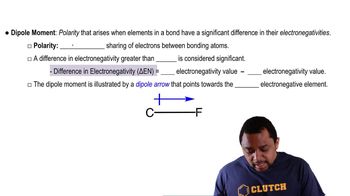
Determine the direction of the dipole moment. The dipole arrow points from the less electronegative atom to the more electronegative atom.
In the Si―Cl bond, chlorine (Cl) is more electronegative than silicon (Si).
Draw the dipole arrow starting at the silicon (Si) atom and pointing towards the chlorine (Cl) atom.
Label the dipole arrow with a positive sign (δ+) near the silicon (Si) and a negative sign (δ-) near the chlorine (Cl) to indicate the direction of electron density shift.
Verified video answer for a similar problem:
This video solution was recommended by our tutors as helpful for the problem above
Video duration:
2m
Play a video:
0 Comments
Key Concepts
Here are the essential concepts you must grasp in order to answer the question correctly.
Electronegativity
Electronegativity is a measure of an atom's ability to attract and hold onto electrons in a chemical bond. In the case of the Si-Cl bond, silicon (Si) has a lower electronegativity compared to chlorine (Cl), which means that Cl will attract the shared electrons more strongly, creating a polar bond.
A polar covalent bond occurs when two atoms share electrons unequally due to differences in their electronegativities. In the Si-Cl bond, the unequal sharing of electrons results in a dipole moment, where one end of the bond is slightly negative (Cl) and the other end is slightly positive (Si), indicated by a dipole arrow pointing towards the more electronegative atom.
The dipole moment is a vector quantity that represents the separation of positive and negative charges in a polar molecule. It is depicted by a dipole arrow, which points from the positive end to the negative end of the bond. In the Si-Cl bond, the dipole arrow would point from silicon to chlorine, illustrating the direction of electron density and the bond's polarity.