To solve each problem, refer to the formulas for compound interest. A = P (1 + r/n)tn and A = Pert Find t, to the nearest hundredth of a year, if \$1786 becomes \$2063 at 2.6%, with interest compounded monthly.
Ch. 4 - Inverse, Exponential, and Logarithmic Functions

Chapter 5, Problem 103
Use properties of logarithms to rewrite each function, and describe how the graph of the given function compares to the graph of g(x) = ln x. ƒ(x) = ln(e2x)
Verified step by step guidance1
Start by recognizing the given function: \(\displaystyle f(x) = \ln(e^{2}x)\). Notice that the argument of the logarithm is a product of \(e^{2}\) and \(x\).
Use the logarithm property that states \(\ln(ab) = \ln a + \ln b\) to separate the logarithm of the product: \(\ln(e^{2}x) = \ln(e^{2}) + \ln(x)\).
Recall that \(\ln(e^{k}) = k\) for any constant \(k\), so simplify \(\ln(e^{2})\) to \(2\). This gives \(f(x) = 2 + \ln(x)\).
Interpret the transformation: since \(f(x) = \ln(x) + 2\), this represents a vertical shift of the graph of \(g(x) = \ln x\) upward by 2 units.
Summarize the effect on the graph: the shape of the graph remains the same as \(g(x) = \ln x\), but every point is moved 2 units higher on the y-axis.
Key Concepts
Here are the essential concepts you must grasp in order to answer the question correctly.
Properties of Logarithms
Properties of logarithms include rules such as the product, quotient, and power rules. For example, ln(a^b) = b ln(a), and ln(ab) = ln(a) + ln(b). These properties allow us to simplify or rewrite logarithmic expressions to make them easier to analyze or graph.
Recommended video:
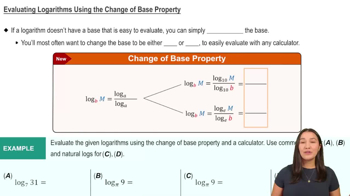
Change of Base Property
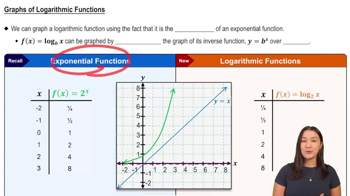
Natural Logarithm Function g(x) = ln(x)
The natural logarithm function ln(x) is the inverse of the exponential function e^x. Its graph passes through (1,0), is defined for x > 0, and increases slowly. Understanding its shape and domain is essential for comparing transformations of logarithmic functions.
Recommended video:
Graphs of Logarithmic Functions
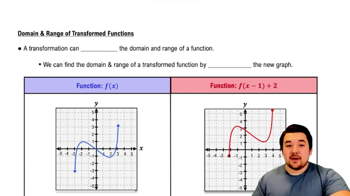
Function Transformations and Graph Comparisons
Transformations such as shifts, stretches, and compressions affect the graph of a function. When rewriting ƒ(x) = ln(e^{2x}), recognizing it simplifies to a linear transformation of ln(x) helps describe how its graph compares to g(x) = ln(x), such as horizontal scaling or vertical shifts.
Recommended video:
Domain & Range of Transformed Functions
Related Practice
Textbook Question
2
views
Textbook Question
Use the properties of inverses to determine whether ƒ and g are inverses. ƒ(x) = log↓2 x+1, g(x) = 2x-1
Textbook Question
Use the properties of inverses to determine whether ƒ and g are inverses. ƒ(x) = 5^x, g(x) = log↓5 x
Textbook Question
To solve each problem, refer to the formulas for compound interest. A = P (1 + r/n)tn and A = Pert At what interest rate, to the nearest hundredth of a percent, will \$16,000 grow to \$20,000 if invested for 7.25 yr and interest is compounded quarterly?
Textbook Question
Use properties of logarithms to rewrite each function, then graph. ƒ(x) = log3 [9 (x+2) ]
Textbook Question
Use properties of logarithms to rewrite each function, then graph. ƒ(x) = log3 (x+1)/9