Ch. 4 - Inverse, Exponential, and Logarithmic Functions
Lial - College Algebra 13th Edition
Lial13th EditionCollege AlgebraISBN: 9780136881063Not the one you use?Change textbook
Chapter 5, Problem 102

To solve each problem, refer to the formulas for compound interest. A = P (1 + r/n)tn and A = Pert Find t, to the nearest hundredth of a year, if \$1786 becomes \$2063 at 2.6%, with interest compounded monthly.

Verified step by step guidance
1
Identify the given values: the principal amount \(P = 1786\), the amount after time \(A = 2063\), the annual interest rate \(r = 2.6\% = 0.026\), and the compounding frequency \(n = 12\) (monthly).
Write down the compound interest formula for interest compounded periodically: \(A = P \left(1 + \frac{r}{n}\right)^{nt}\).
Substitute the known values into the formula: \(2063 = 1786 \left(1 + \frac{0.026}{12}\right)^{12t}\).
Divide both sides by 1786 to isolate the exponential term: \(\frac{2063}{1786} = \left(1 + \frac{0.026}{12}\right)^{12t}\).
Take the natural logarithm of both sides to solve for \(t\): \(\ln\left(\frac{2063}{1786}\right) = 12t \cdot \ln\left(1 + \frac{0.026}{12}\right)\). Then, solve for \(t\) by dividing both sides by \(12 \cdot \ln\left(1 + \frac{0.026}{12}\right)\).

Verified video answer for a similar problem:

This video solution was recommended by our tutors as helpful for the problem above.
Video duration:
8m
Was this helpful?

Key Concepts

Here are the essential concepts you must grasp in order to answer the question correctly.

Compound Interest Formula

The compound interest formula calculates the amount A accumulated over time with principal P, interest rate r, number of compounding periods n per year, and time t in years. It is given by A = P(1 + r/n)^(nt), which accounts for interest being added periodically, causing exponential growth.
Recommended video:
06:36
Solving Quadratic Equations Using The Quadratic Formula

Solving for Time in Exponential Equations

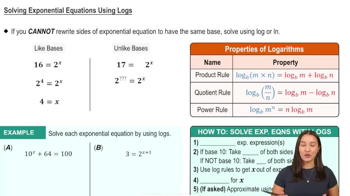
To find the time t in compound interest problems, you often need to solve an exponential equation. This involves isolating the exponential term and using logarithms to solve for t, since t appears as an exponent in the formula.
Recommended video:
5:47
Solving Exponential Equations Using Logs

Interest Rate and Compounding Frequency

The interest rate r must be expressed as a decimal, and the compounding frequency n affects how often interest is added. Monthly compounding means n = 12, which influences the growth rate and the calculation of time needed for an investment to reach a certain amount.
Recommended video:
4:47
The Number e