To solve each problem, refer to the formulas for compound interest. A = P (1 + r/n)tn and A = Pert Find t, to the nearest hundredth of a year, if \$1786 becomes \$2063 at 2.6%, with interest compounded monthly.
Ch. 4 - Inverse, Exponential, and Logarithmic Functions

Chapter 5, Problem 100
Work each problem. Which of the following is equivalent to ln(4x) - ln(2x) for x > 0? A. 2 ln x B. ln 2x C. (ln 4x)/(ln 2x) D. ln 2
Verified step by step guidance1
Recall the logarithmic property that states: \(\ln a - \ln b = \ln \left( \frac{a}{b} \right)\) for positive values of \(a\) and \(b\).
Apply this property to the expression \(\ln(4x) - \ln(2x)\) by writing it as \(\ln \left( \frac{4x}{2x} \right)\).
Simplify the fraction inside the logarithm: \(\frac{4x}{2x} = 2\) since \(x > 0\) and cancels out.
Rewrite the expression as \(\ln(2)\) after simplification.
Compare the simplified expression \(\ln(2)\) with the given options to identify the equivalent expression.

Verified video answer for a similar problem:
This video solution was recommended by our tutors as helpful for the problem above.
Video duration:
1mWas this helpful?
Key Concepts
Here are the essential concepts you must grasp in order to answer the question correctly.
Properties of Logarithms
Logarithms have specific properties that simplify expressions, such as the difference rule: ln(a) - ln(b) = ln(a/b). This property allows combining or breaking down logarithmic expressions by converting subtraction into division inside a single logarithm.
Recommended video:
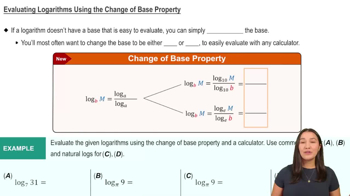
Change of Base Property
Domain Restrictions for Logarithmic Functions
The argument of a logarithm must be positive, so for ln(4x) and ln(2x), x must be greater than zero. Understanding domain restrictions ensures the expression is valid and helps avoid undefined values during simplification.
Recommended video:
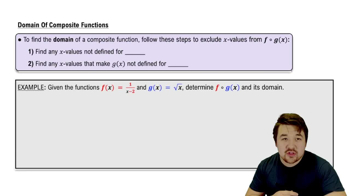
Domain Restrictions of Composed Functions
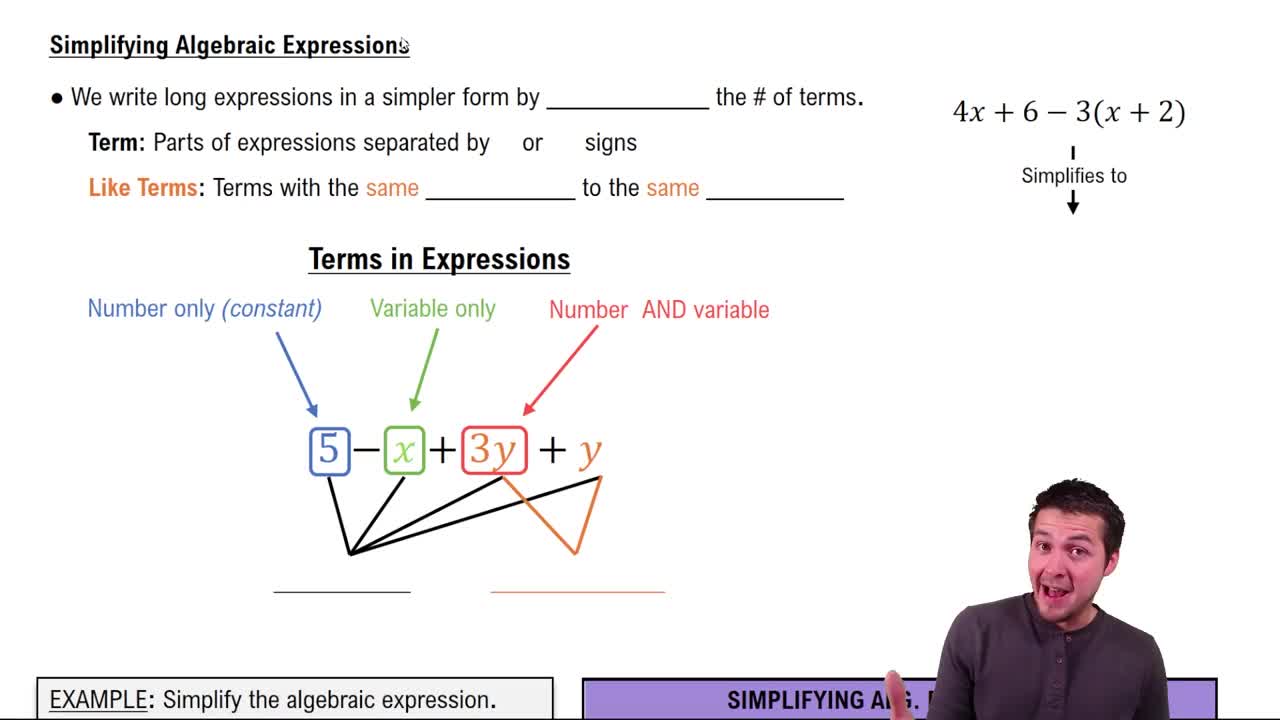
Simplifying Algebraic Expressions Inside Logarithms
When simplifying ln(4x) - ln(2x), use algebraic manipulation inside the logarithm: (4x)/(2x) simplifies to 2, since x > 0. Recognizing how to simplify fractions inside logarithms is key to finding the equivalent expression.
Recommended video:
Guided course
Simplifying Algebraic Expressions
Related Practice
Textbook Question
2
views
Textbook Question
Work each problem. Which of the following is equivalent to 2 ln(3x) for x > 0?
A. ln 9 + ln x
B. ln 6x
C. ln 6 + ln x
D. ln 9x2
5
views
Textbook Question
Use the various properties of exponential and logarithmic functions to evaluate the expressions in parts (a)–(c). Given ƒ(x) = log2 x, find ƒ(22 log_2 2)
Textbook Question
Use properties of logarithms to rewrite each function, then graph. ƒ(x) = log2 [4 (x-3) ]
Textbook Question
Given that log10 2 ≈ 0.3010 and log10 3 ≈ 0.4771, find each logarithm without using a calculator. log10 √30
1
views
Textbook Question
Use properties of logarithms to rewrite each function, then graph. ƒ(x) = log3 [9 (x+2) ]