Ch. 4 - Inverse, Exponential, and Logarithmic Functions
Lial - College Algebra 13th Edition
Lial13th EditionCollege AlgebraISBN: 9780136881063Not the one you use?Change textbook
Chapter 5, Problem 99

Work each problem. Which of the following is equivalent to 2 ln(3x) for x > 0?
A. ln 9 + ln x
B. ln 6x
C. ln 6 + ln x
D. ln 9x2

Verified step by step guidance
1
Recall the logarithmic property that states: \(a \ln b = \ln b^a\). This means you can rewrite \(2 \ln(3x)\) as \(\ln((3x)^2)\).
Apply the exponent inside the logarithm: \((3x)^2 = 3^2 \times x^2 = 9x^2\). So, \(2 \ln(3x) = \ln(9x^2)\).
Recognize that \(\ln(9x^2)\) can be separated using the logarithm product rule: \(\ln(ab) = \ln a + \ln b\). Therefore, \(\ln(9x^2) = \ln 9 + \ln x^2\).
Use the power rule for logarithms on \(\ln x^2\): \(\ln x^2 = 2 \ln x\). So, \(\ln(9x^2) = \ln 9 + 2 \ln x\).
Compare the expression \(\ln(9x^2)\) with the given options to identify which one matches \(2 \ln(3x)\).

Verified video answer for a similar problem:

This video solution was recommended by our tutors as helpful for the problem above.
Video duration:
2m
Was this helpful?

Key Concepts

Here are the essential concepts you must grasp in order to answer the question correctly.

Properties of Logarithms

Logarithms have specific properties that simplify expressions, such as the product rule (ln a + ln b = ln(ab)) and the power rule (k ln a = ln(a^k)). These rules allow rewriting complex logarithmic expressions into simpler or equivalent forms.
Recommended video:
5:36
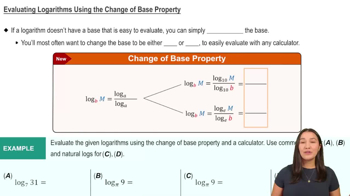
Change of Base Property

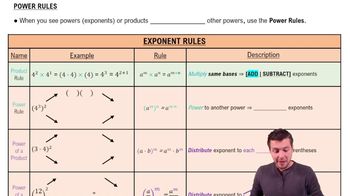
Power Rule for Logarithms

The power rule states that multiplying a logarithm by a constant is equivalent to taking the logarithm of the argument raised to that constant: k ln(a) = ln(a^k). This is essential for rewriting expressions like 2 ln(3x) as ln((3x)^2).
Recommended video:

Domain Restrictions in Logarithmic Functions

Logarithmic functions are defined only for positive arguments. For ln(3x), the domain restriction x > 0 ensures the argument 3x is positive, which is necessary for the expression to be valid and for applying logarithmic properties correctly.
Recommended video:
3:51
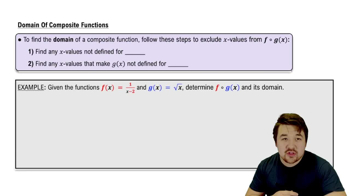
Domain Restrictions of Composed Functions