Use the properties of inverses to determine whether ƒ and g are inverses. ƒ(x) = log↓2 x+1, g(x) = 2x-1
Ch. 4 - Inverse, Exponential, and Logarithmic Functions

Chapter 5, Problem 105
Use the properties of inverses to determine whether ƒ and g are inverses. ƒ(x) = 5^x, g(x) = log↓5 x
Verified step by step guidance1
Recall that two functions \( f \) and \( g \) are inverses if and only if \( f(g(x)) = x \) and \( g(f(x)) = x \) for all \( x \) in the domains of \( g \) and \( f \), respectively.
Start by finding the composition \( f(g(x)) \). Substitute \( g(x) = \log_5 x \) into \( f \): \[ f(g(x)) = f(\log_5 x) = 5^{\log_5 x} \].
Use the property of logarithms and exponents that \( a^{\log_a x} = x \) to simplify \( 5^{\log_5 x} \) to \( x \). This shows that \( f(g(x)) = x \).
Next, find the composition \( g(f(x)) \). Substitute \( f(x) = 5^x \) into \( g \): \[ g(f(x)) = g(5^x) = \log_5 (5^x) \].
Use the logarithm property \( \log_a (a^x) = x \) to simplify \( \log_5 (5^x) \) to \( x \). This shows that \( g(f(x)) = x \). Since both compositions simplify to \( x \), \( f \) and \( g \) are inverses.

Verified video answer for a similar problem:
This video solution was recommended by our tutors as helpful for the problem above.
Video duration:
4mWas this helpful?
Key Concepts
Here are the essential concepts you must grasp in order to answer the question correctly.
Inverse Functions
Inverse functions undo each other's operations. If f and g are inverses, then applying f followed by g (or vice versa) returns the original input, i.e., g(f(x)) = x and f(g(x)) = x for all x in the domains. This property is essential to verify if two functions are inverses.
Recommended video:
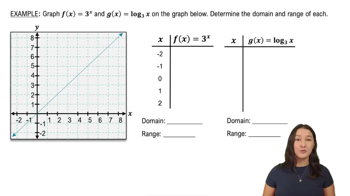
Graphing Logarithmic Functions
Exponential Functions
An exponential function has the form f(x) = a^x, where a is a positive constant not equal to 1. It grows rapidly and is one-to-one, meaning it passes the horizontal line test, which allows it to have an inverse function. Understanding its behavior helps in analyzing its inverse.
Recommended video:
Exponential Functions
Logarithmic Functions
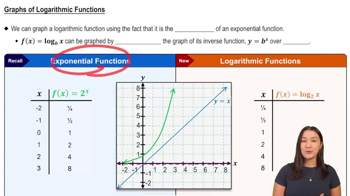
A logarithmic function is the inverse of an exponential function and is defined as g(x) = log_a(x), where a is the base. It satisfies the property that log_a(a^x) = x and a^(log_a x) = x. Recognizing this relationship is key to determining if two functions are inverses.
Recommended video:
Graphs of Logarithmic Functions
Related Practice
Textbook Question
Textbook Question
Write an equation for the inverse function of each one-to-one function given. ƒ(x) = 3x
Textbook Question
To solve each problem, refer to the formulas for compound interest. A = P (1 + r/n)tn and A = Pert At what interest rate, to the nearest hundredth of a percent, will \$16,000 grow to \$20,000 if invested for 7.25 yr and interest is compounded quarterly?
Textbook Question
Use properties of logarithms to rewrite each function, and describe how the graph of the given function compares to the graph of g(x) = ln x. ƒ(x) = ln(e2x)
Textbook Question
Use the properties of inverses to determine whether ƒ and g are inverses. ƒ(x) = log↓4 (x+3), g(x) = 4x + 3
4
views
Textbook Question
Use properties of logarithms to rewrite each function, then graph. ƒ(x) = log3 (x+1)/9