Ch. 4 - Inverse, Exponential, and Logarithmic Functions
Lial - College Algebra 13th Edition
Lial13th EditionCollege AlgebraISBN: 9780136881063Not the one you use?Change textbook
Chapter 5, Problem 107

Use the properties of inverses to determine whether ƒ and g are inverses. ƒ(x) = log↓2 x+1, g(x) = 2x-1

Verified step by step guidance
1
Recall that two functions \( f \) and \( g \) are inverses if and only if \( f(g(x)) = x \) and \( g(f(x)) = x \) for all \( x \) in the domains of the compositions.
Start by finding the composition \( f(g(x)) \). Substitute \( g(x) = 2^{x} - 1 \) into \( f(x) = \log_{2}(x + 1) \), so \( f(g(x)) = \log_{2}((2^{x} - 1) + 1) \).
Simplify the expression inside the logarithm: \( (2^{x} - 1) + 1 = 2^{x} \), so \( f(g(x)) = \log_{2}(2^{x}) \).
Use the logarithm property \( \log_{b}(b^{k}) = k \) to simplify \( \log_{2}(2^{x}) = x \). This shows that \( f(g(x)) = x \).
Next, find the composition \( g(f(x)) \). Substitute \( f(x) = \log_{2}(x + 1) \) into \( g(x) = 2^{x} - 1 \), so \( g(f(x)) = 2^{\log_{2}(x + 1)} - 1 \). Using the property \( b^{\log_{b}(y)} = y \), simplify to \( (x + 1) - 1 = x \). This shows that \( g(f(x)) = x \).

Verified video answer for a similar problem:

This video solution was recommended by our tutors as helpful for the problem above.
Video duration:
4m
Was this helpful?

Key Concepts

Here are the essential concepts you must grasp in order to answer the question correctly.

Inverse Functions

Inverse functions undo each other's operations. If f and g are inverses, then f(g(x)) = x and g(f(x)) = x for all x in their domains. This means applying one function after the other returns the original input.
Recommended video:
4:30
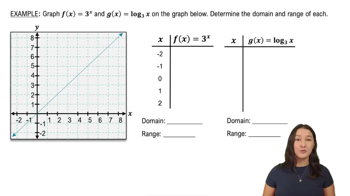
Graphing Logarithmic Functions

Properties of Logarithms and Exponents

Logarithms and exponents are inverse operations. Specifically, log base 2 and 2 raised to a power undo each other, such that log₂(2^x) = x and 2^(log₂ x) = x. Understanding this relationship helps verify if two functions are inverses.
Recommended video:
5:36
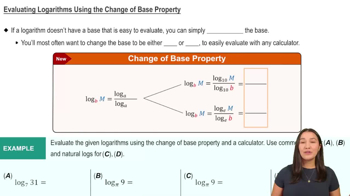
Change of Base Property

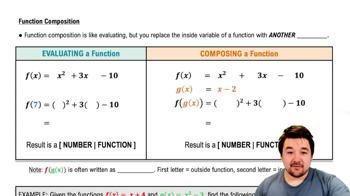
Function Composition

Function composition involves applying one function to the result of another, denoted as (f ∘ g)(x) = f(g(x)). To check if two functions are inverses, compose them in both orders and verify if the result simplifies to x.
Recommended video:
4:56
Function Composition