Ch. 2 - Functions and Graphs
Blitzer - College Algebra 8th Edition
Blitzer8th EditionCollege AlgebraISBN: 9780136970514Not the one you use?Change textbook
Chapter 3, Problem 84

Begin by graphing the absolute value function, f(x) = |x|. Then use transformations of this graph to graph the given function. g(x) = |x+3|

Verified step by step guidance
1
Start by graphing the parent function f(x) = |x|. This is a V-shaped graph with its vertex at the origin (0, 0). The graph opens upwards, with the left side having a slope of -1 and the right side having a slope of 1.
Next, analyze the given function g(x) = |x + 3|. Notice that the expression inside the absolute value, x + 3, indicates a horizontal shift. Specifically, adding 3 inside the absolute value shifts the graph to the left by 3 units.
To apply the transformation, take each point on the graph of f(x) = |x| and shift it 3 units to the left. For example, the vertex of f(x) = |x| at (0, 0) will move to (-3, 0).
Redraw the graph with the new vertex at (-3, 0). The V-shape remains the same, with the left side having a slope of -1 and the right side having a slope of 1, but the entire graph is now centered at x = -3.
Label the graph of g(x) = |x + 3| clearly, and verify that the transformation has been applied correctly by checking a few points. For instance, when x = -3, g(x) = |(-3) + 3| = 0, and when x = -4, g(x) = |(-4) + 3| = 1.

Verified video answer for a similar problem:

This video solution was recommended by our tutors as helpful for the problem above.
Video duration:
1m
Was this helpful?

Key Concepts

Here are the essential concepts you must grasp in order to answer the question correctly.

Absolute Value Function

The absolute value function, denoted as f(x) = |x|, outputs the non-negative value of x. This means that for any input x, the function returns x if x is positive or zero, and -x if x is negative. The graph of this function is a V-shape, with its vertex at the origin (0,0), and it is symmetric about the y-axis.
Recommended video:
4:56
Function Composition

Graph Transformations

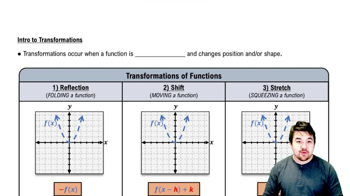
Graph transformations involve shifting, reflecting, stretching, or compressing the graph of a function. In this case, the function g(x) = |x + 3| represents a horizontal shift of the absolute value function f(x) = |x|. Specifically, it shifts the graph 3 units to the left, moving the vertex from (0,0) to (-3,0).
Recommended video:
5:25
Intro to Transformations

Function Composition

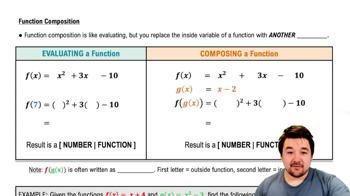
Function composition refers to the process of applying one function to the results of another. In the context of transformations, we can think of g(x) as a composition of the absolute value function with a linear function that shifts the input. Understanding how to manipulate the input of a function is crucial for accurately graphing transformed functions.
Recommended video:
4:56
Function Composition