Ch. 2 - Functions and Graphs
Blitzer - College Algebra 8th Edition
Blitzer8th EditionCollege AlgebraISBN: 9780136970514Not the one you use?Change textbook
Chapter 3, Problem 84

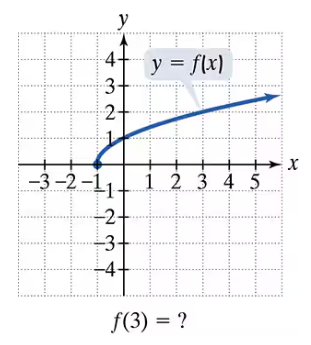
In Exercises 77–92, use the graph to determine a. the function's domain; b. the function's range; c. the x-intercepts, if any; d. the y-intercept, if any; and e. the missing function values, indicated by question marks, below each graph.
Graph of a function increasing from (-2,1) through (0,1) to (5,3) with missing value f(3) indicated.

Verified step by step guidance
1
Step 1: Determine the domain by looking at the x-values over which the function is defined. From the graph, the function starts at x = -2 and continues to the right, so the domain is all x-values from -2 to 5 (or beyond if the graph extends).
Step 2: Determine the range by observing the y-values the function takes. The graph starts at y = 1 when x = -2 and increases to about y = 3 at x = 5, so the range is from 1 to approximately 3.
Step 3: Identify the x-intercepts by finding where the graph crosses the x-axis (y = 0). Since the graph is above y = 0 for all shown x-values, there are no x-intercepts.
Step 4: Identify the y-intercept by finding where the graph crosses the y-axis (x = 0). From the graph, at x = 0, y = 1, so the y-intercept is (0, 1).
Step 5: Find the missing function value f(3) by locating x = 3 on the x-axis and reading the corresponding y-value on the graph. From the graph, at x = 3, the y-value is approximately 2, so f(3) = 2.

Verified video answer for a similar problem:

This video solution was recommended by our tutors as helpful for the problem above.
Video duration:
3m
Was this helpful?

Key Concepts

Here are the essential concepts you must grasp in order to answer the question correctly.

Domain of a Function

The domain of a function is the set of all possible input values (x-values) for which the function is defined. On a graph, the domain corresponds to the horizontal extent of the curve, showing all x-values covered by the function. Identifying the domain helps determine where the function exists on the x-axis.
Recommended video:
3:51
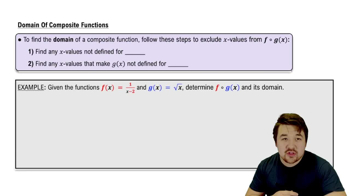
Domain Restrictions of Composed Functions

Range of a Function

The range of a function is the set of all possible output values (y-values) that the function can produce. On a graph, the range corresponds to the vertical extent of the curve, showing all y-values the function attains. Understanding the range helps describe the behavior and limits of the function's outputs.
Recommended video:
4:22
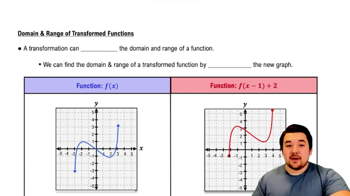
Domain & Range of Transformed Functions

Evaluating Function Values from a Graph

To find a specific function value like f(3), locate the input x = 3 on the x-axis and find the corresponding point on the graph. The y-coordinate of this point is the function value f(3). This process allows you to determine missing values by reading the graph accurately.
Recommended video:
4:26
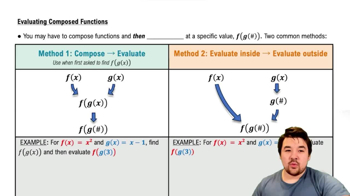
Evaluating Composed Functions