Ch. 2 - Functions and Graphs
Blitzer - College Algebra 8th Edition
Blitzer8th EditionCollege AlgebraISBN: 9780136970514Not the one you use?Change textbook
Chapter 3, Problem 78

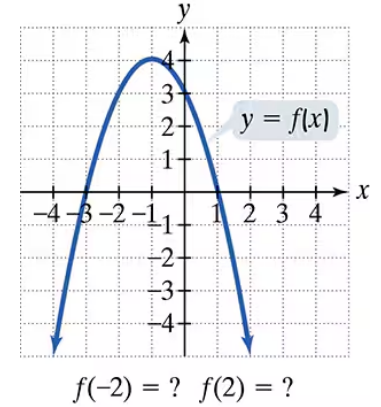
Use the graph to determine a.the x-intercepts, if any; b. the y-intercept, if any; and e. the missing function values, indicated by question marks, below each graph.

Verified step by step guidance
1
Identify the x-intercepts by finding the points where the graph crosses the x-axis. These are points where the y-value is zero. From the graph, note the x-values at these points.
Identify the y-intercept by finding the point where the graph crosses the y-axis. This is the point where the x-value is zero. From the graph, note the y-value at this point.
To find the missing function values indicated by question marks, locate the corresponding x-values on the graph and determine the y-values by reading the height of the graph at those points.
Write down the coordinates of the x-intercepts and y-intercept clearly in the form \((x, 0)\) for x-intercepts and \((0, y)\) for the y-intercept.
Use the identified points to understand the behavior of the function and verify the missing values by checking if they align with the shape and trend of the graph.

Verified video answer for a similar problem:

This video solution was recommended by our tutors as helpful for the problem above.
Video duration:
3m
Was this helpful?

Key Concepts

Here are the essential concepts you must grasp in order to answer the question correctly.

X-Intercepts

X-intercepts are points where the graph crosses the x-axis, meaning the y-value is zero at these points. Identifying x-intercepts involves finding the values of x for which the function equals zero. In the graph, these are marked as (0,0) and (5,0).
Recommended video:
Guided course
04:08
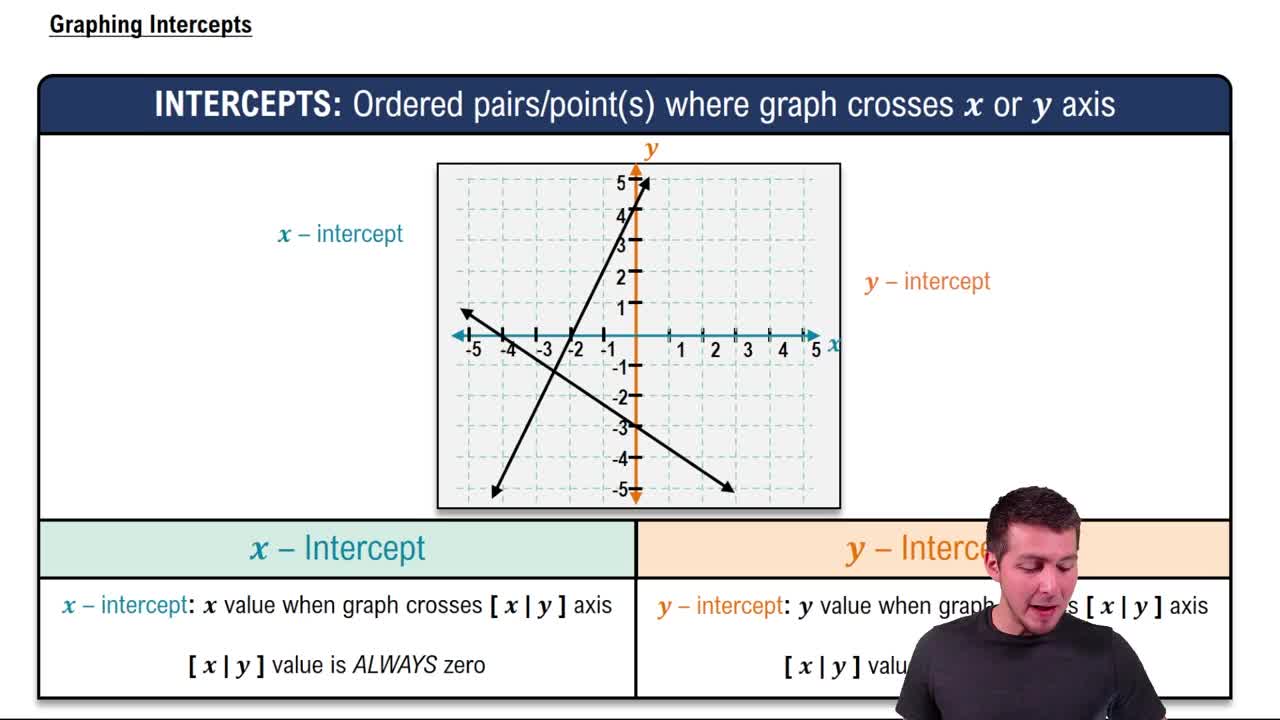
Graphing Intercepts

Y-Intercept

The y-intercept is the point where the graph crosses the y-axis, which occurs when x equals zero. This point shows the initial value of the function. In the graph, the y-intercept is at (0,7), indicating the function's value when x is zero.
Recommended video:
Guided course
04:08
Graphing Intercepts

Reading Function Values from a Graph

To determine missing function values, analyze the graph's points and their coordinates. Each point on the curve corresponds to an (x, y) pair, where y is the function value at x. Using the graph, you can estimate or identify exact values to fill in missing data.
Recommended video:
5:46
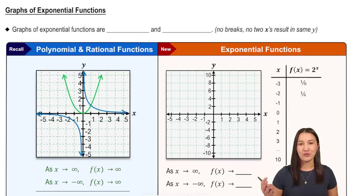
Graphs of Exponential Functions