Express the given function h as a composition of two functions ƒ and g so that h(x) = (fog) (x). h(x) = ∛(x² – 9)
Ch. 2 - Functions and Graphs

Chapter 3, Problem 78
Begin by graphing the square root function, f(x) = √x. Then use transformations of this graph to graph the given function. h(x) = √(x+1)-1
Verified step by step guidance1
Step 1: Begin by graphing the parent function f(x) = √x. This function is defined for x ≥ 0 and has a domain of [0, ∞). The graph starts at the origin (0, 0) and increases gradually, curving upward as x increases.
Step 2: Analyze the given function h(x) = √(x+1) - 1. Notice that this function involves two transformations applied to the parent function f(x) = √x.
Step 3: The term (x+1) inside the square root indicates a horizontal shift. Specifically, the graph of f(x) = √x is shifted 1 unit to the left because adding 1 to x moves the graph in the opposite direction.
Step 4: The term -1 outside the square root indicates a vertical shift. This means the graph is shifted 1 unit downward. Apply this transformation after the horizontal shift.
Step 5: Combine both transformations to graph h(x). Start by shifting the graph of f(x) = √x 1 unit to the left, then shift the resulting graph 1 unit downward. The domain of h(x) is adjusted to x ≥ -1 because the square root function is only defined for non-negative values inside the radical.

Verified video answer for a similar problem:
This video solution was recommended by our tutors as helpful for the problem above.
Video duration:
4mWas this helpful?
Key Concepts
Here are the essential concepts you must grasp in order to answer the question correctly.
Square Root Function
The square root function, f(x) = √x, is defined for x ≥ 0 and produces non-negative outputs. Its graph is a curve that starts at the origin (0,0) and increases gradually, reflecting the relationship between the input and its square root. Understanding this function is crucial as it serves as the foundation for applying transformations.
Recommended video:
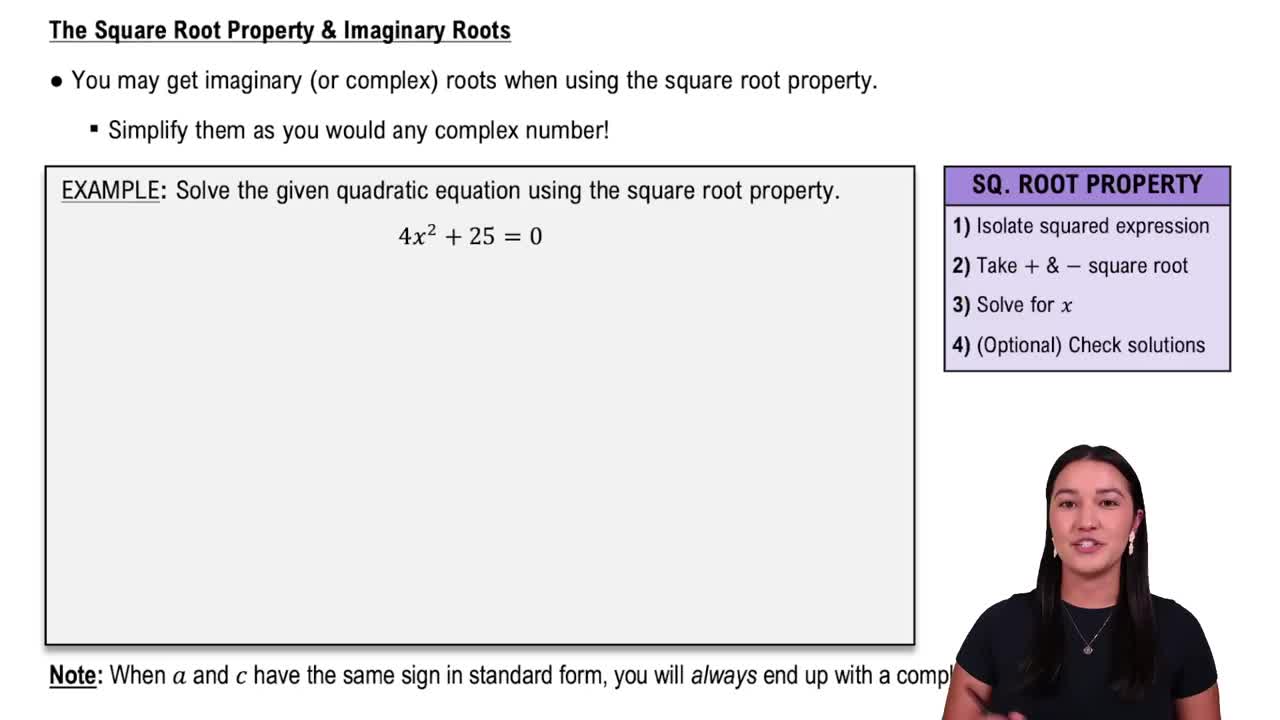
Imaginary Roots with the Square Root Property
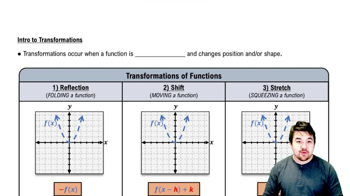
Graph Transformations
Graph transformations involve shifting, stretching, compressing, or reflecting the graph of a function. For the function h(x) = √(x+1) - 1, the graph of f(x) = √x is shifted left by 1 unit and down by 1 unit. Recognizing these transformations allows for the accurate depiction of how the original function is altered.
Recommended video:
Intro to Transformations
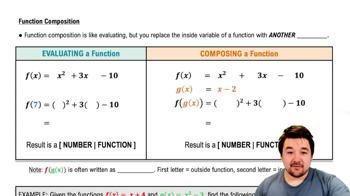
Function Composition
Function composition refers to the process of applying one function to the results of another. In this context, h(x) can be viewed as a composition of the square root function and the transformations applied to it. Understanding how to compose functions helps in visualizing and calculating the effects of transformations on the original function.
Recommended video:
Function Composition
Related Practice
Textbook Question
Textbook Question
In Exercises 77–92, use the graph to determine a. the function's domain; b. the function's range; and e. the missing function values, indicated by question marks, below each graph.
1
views
Textbook Question
Give the slope and y-intercept of each line whose equation is given. Assume that B ≠ 0. Ax = By - C
Textbook Question
Use the graph to determine a.the x-intercepts, if any; b. the y-intercept, if any; and e. the missing function values, indicated by question marks, below each graph.
Textbook Question
In Exercises 77–92, use the graph to determine a.the x-intercepts, if any; b. the y-intercept, if any; and e. the missing function values, indicated by question marks, below each graph.
2
views
Textbook Question
Find the domain of each function. g(x) = 4/(x - 7)