Express the given function h as a composition of two functions ƒ and g so that h(x) = (fog) (x). h(x) = ∛(x² – 9)
Ch. 2 - Functions and Graphs

Chapter 3, Problem 78
Give the slope and y-intercept of each line whose equation is given. Assume that B ≠ 0. Ax = By - C
Verified step by step guidance1
Start with the given equation: \(Ax = By - C\).
Rearrange the equation to solve for \(y\) in terms of \(x\). Add \(C\) to both sides and then divide both sides by \(B\):
\(By = Ax + C \implies y = \frac{A}{B}x + \frac{C}{B}\).
Identify the slope \(m\) from the equation in slope-intercept form \(y = mx + b\). Here, the slope is \(m = \frac{A}{B}\).
Identify the y-intercept \(b\) from the equation. The y-intercept is the constant term \(b = \frac{C}{B}\).
Summarize: The slope of the line is \(\frac{A}{B}\) and the y-intercept is \(\frac{C}{B}\).

Verified video answer for a similar problem:
This video solution was recommended by our tutors as helpful for the problem above.
Video duration:
2mWas this helpful?
Key Concepts
Here are the essential concepts you must grasp in order to answer the question correctly.
Slope-Intercept Form of a Line
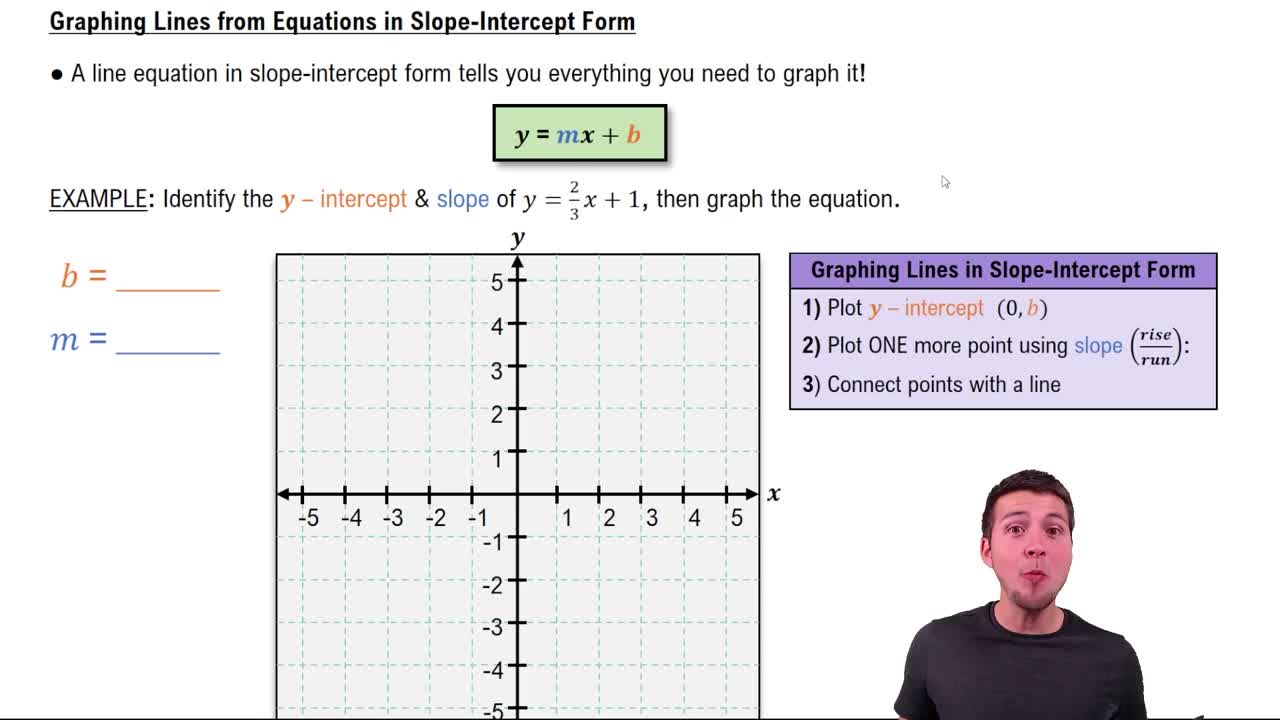
The slope-intercept form of a line is y = mx + b, where m represents the slope and b represents the y-intercept. Converting a given equation into this form helps identify these values directly.
Recommended video:
Guided course
Graphing Lines in Slope-Intercept Form
Rearranging Linear Equations
To find the slope and y-intercept from an equation like Ax = By - C, you must isolate y on one side. This involves algebraic manipulation such as adding, subtracting, and dividing terms to rewrite the equation in slope-intercept form.
Recommended video:
Categorizing Linear Equations
Slope and Y-Intercept Definitions
The slope measures the steepness of a line, calculated as the ratio of vertical change to horizontal change. The y-intercept is the point where the line crosses the y-axis, found by setting x = 0 in the equation.
Recommended video:
Guided course
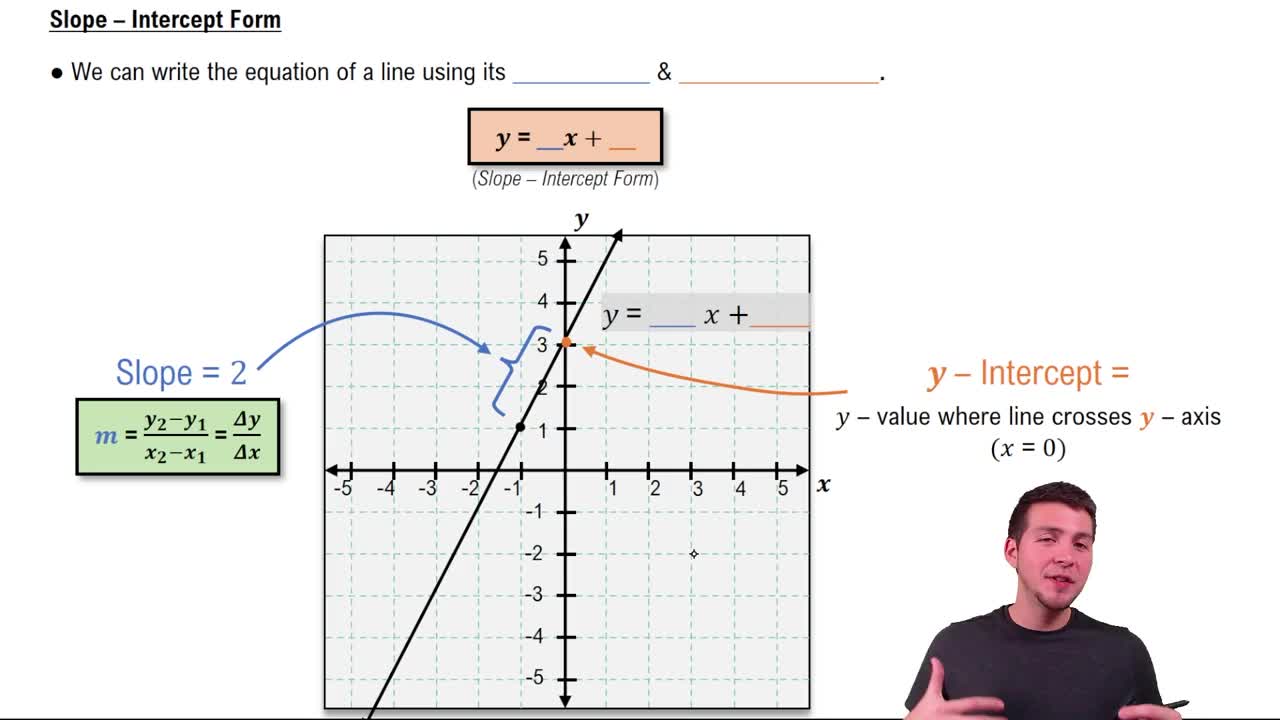
Slope-Intercept Form
Related Practice
Textbook Question
Textbook Question
Begin by graphing the square root function, f(x) = √x. Then use transformations of this graph to graph the given function. h(x) = √(x+1)-1
Textbook Question
Use the graph to determine a.the x-intercepts, if any; b. the y-intercept, if any; and e. the missing function values, indicated by question marks, below each graph.
Textbook Question
In Exercises 77–92, use the graph to determine a.the x-intercepts, if any; b. the y-intercept, if any; and e. the missing function values, indicated by question marks, below each graph.
2
views
Textbook Question
Find the domain of each function. g(x) = 4/(x - 7)
Textbook Question
In Exercises 77–92, use the graph to determine a.the x-intercepts, if any; b. the y-intercept, if any; and e. the missing function values, indicated by question marks, below each graph.
3
views