Ch. 7 - Transcendental Functions
Hass - Thomas' Calculus 15th Edition
Hass15th EditionThomas' CalculusISBN: 9780137616077Not the one you use?Change textbook
Chapter 7, Problem 7.6.2b

Use reference triangles in an appropriate quadrant to find the angles in Exercises 1–8.
2. b. tan^(-1)(√3)

Verified step by step guidance
1
Recognize that the problem asks for the angle whose tangent value is \( \sqrt{3} \), which means we want to find \( \theta = \tan^{-1}(\sqrt{3}) \).
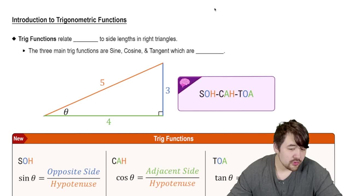
Recall the definition of tangent in a right triangle: \( \tan(\theta) = \frac{\text{opposite}}{\text{adjacent}} \). Here, the ratio is \( \sqrt{3} \) to 1.
Construct a reference triangle where the side opposite the angle \( \theta \) is \( \sqrt{3} \) and the adjacent side is 1. Use the Pythagorean theorem to find the hypotenuse: \( \text{hypotenuse} = \sqrt{(\sqrt{3})^2 + 1^2} = \sqrt{3 + 1} = 2 \).
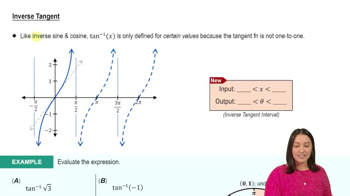
Identify the angle \( \theta \) in the first quadrant (since inverse tangent outputs angles between \( -\frac{\pi}{2} \) and \( \frac{\pi}{2} \)) that corresponds to this triangle. This angle is commonly known from special triangles.
Conclude that the angle \( \theta = \tan^{-1}(\sqrt{3}) \) corresponds to the angle in the reference triangle with opposite side \( \sqrt{3} \), adjacent side 1, and hypotenuse 2, which is a standard angle in trigonometry.

Verified video answer for a similar problem:

This video solution was recommended by our tutors as helpful for the problem above.
Video duration:
2m
Was this helpful?

Key Concepts

Here are the essential concepts you must grasp in order to answer the question correctly.

Inverse Tangent Function (arctan)

The inverse tangent function, denoted as tan⁻¹ or arctan, returns the angle whose tangent is a given value. It is used to find an angle when the ratio of the opposite side to the adjacent side in a right triangle is known. The output angle is typically in the range (-π/2, π/2) or (-90°, 90°).
Recommended video:
3:17
Inverse Tangent

Reference Triangles

Reference triangles are right triangles drawn in specific quadrants to help determine the exact angle corresponding to a trigonometric value. They use known side ratios to find angles and adjust for the quadrant by considering the sign of the trigonometric function. This method aids in finding angles beyond the principal range.
Recommended video:
6:04
Introduction to Trigonometric Functions

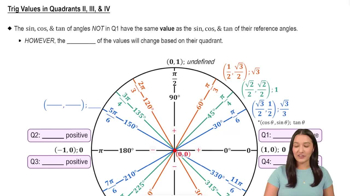
Quadrants and Angle Sign Conventions

The coordinate plane is divided into four quadrants, each with specific sign conventions for sine, cosine, and tangent. Understanding which quadrant an angle lies in helps determine the correct angle measure and sign of the trigonometric function. For example, tangent is positive in the first and third quadrants.
Recommended video:
5:30
Trig Values in Quadrants II, III, & IV