
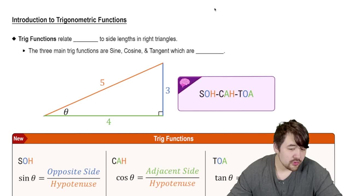
Use reference triangles in an appropriate quadrant to find the angles in Exercises 1–8.
2. b. tan^(-1)(√3)
Verified step by step guidance
Use reference triangles in an appropriate quadrant to find the angles in Exercises 1–8.
2. b. tan^(-1)(√3)
1. Express the following logarithms in terms of ln 2 and ln 3.
b. ln(4/9)
Suppose that the function f and its derivative with respect to x have the following values at x=0, 1, 2, 3, and 4.
Assuming the inverse function f^(-1) is differentiable, find the slope of f^(-1)(x) at
b. x=2
75. b. Identify the function’s local and absolute extreme values, if any, saying where they occur.
g(x) = x(ln x)²
Find the volumes of the solids in Exercises 135 and 136.
135. The solid lies between planes perpendicular to the x-axis at x=-1 and x=1. The cross-sections perpendicular to the x-axis are
b. vertical squares whose base edges run from the curve y=-1/√(1+x²) to the curve y=1/√(1+x²).
In Exercises 67–72, you will explore some functions and their inverses together with their derivatives and tangent line approximations at specified points. Perform the following steps using your CAS:
b. Solve the equation y=f(x) for x as a function of y, and name the resulting inverse function g.
68. y= (3x+2)/(2x-11), -2 ≤ x ≤ 2, x_0=1/2