Ch. 7 - Transcendental Functions
Hass - Thomas' Calculus 15th Edition
Hass15th EditionThomas' CalculusISBN: 9780137616077Not the one you use?Change textbook
Chapter 7, Problem 7.6.135b

Find the volumes of the solids in Exercises 135 and 136.
135. The solid lies between planes perpendicular to the x-axis at x=-1 and x=1. The cross-sections perpendicular to the x-axis are
b. vertical squares whose base edges run from the curve y=-1/√(1+x²) to the curve y=1/√(1+x²).

Verified step by step guidance
1
Identify the interval over which the solid extends along the x-axis, which is from \(x = -1\) to \(x = 1\).
Determine the length of the base of each square cross-section at a given \(x\). The base runs vertically from \(y = -\frac{1}{\sqrt{1+x^2}}\) to \(y = \frac{1}{\sqrt{1+x^2}}\), so the base length is the difference between these two values.
Calculate the base length as \(\text{base} = \frac{1}{\sqrt{1+x^2}} - \left(-\frac{1}{\sqrt{1+x^2}}\right) = \frac{2}{\sqrt{1+x^2}}\).
Since the cross-sections are squares, the area of each cross-section is \(A(x) = \left(\text{base}\right)^2 = \left(\frac{2}{\sqrt{1+x^2}}\right)^2\).
Set up the volume integral by integrating the cross-sectional area along the x-axis: \(V = \int_{-1}^{1} A(x) \, dx = \int_{-1}^{1} \left(\frac{2}{\sqrt{1+x^2}}\right)^2 \, dx\). This integral will give the volume of the solid.

Verified video answer for a similar problem:

This video solution was recommended by our tutors as helpful for the problem above.
Video duration:
5m
Was this helpful?

Key Concepts

Here are the essential concepts you must grasp in order to answer the question correctly.

Volume of a Solid with Known Cross-Sections

This method involves finding the volume of a solid by integrating the area of cross-sectional shapes perpendicular to an axis. For each x-value, the area of the cross-section is computed, then integrated over the given interval to find the total volume.
Recommended video:
05:38
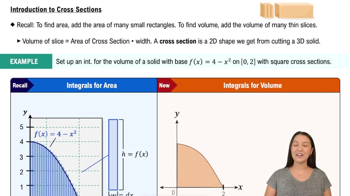
Introduction to Cross Sections

Determining the Side Length of the Square Cross-Section

The side length of each square cross-section is the vertical distance between the two curves y = -1/√(1+x²) and y = 1/√(1+x²). Calculating this length correctly is essential to find the area of the square at each x.
Recommended video:
05:38
Introduction to Cross Sections

Definite Integration over the Interval

Once the area of the cross-section is expressed as a function of x, definite integration from x = -1 to x = 1 sums these areas to find the volume. Understanding how to set up and evaluate this integral is crucial.
Recommended video:
05:43
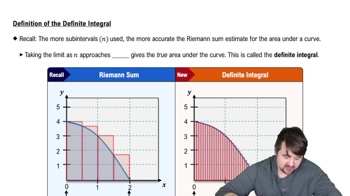
Definition of the Definite Integral