Ch. 7 - Transcendental Functions
Hass - Thomas' Calculus 15th Edition
Hass15th EditionThomas' CalculusISBN: 9780137616077Not the one you use?Change textbook
Chapter 7, Problem 7.5.91.b

91. [Technology Exercise] 91. The continuous extension of to (sin x)^x to [0, π]
b. Verify your conclusion in part (a) by finding lim(x→0⁺)f(x) with l’Hôpital’s Rule.

Verified step by step guidance
1
First, identify the function given: \(f(x) = (\sin x)^x\). Since the problem asks for the continuous extension to the interval \([0, \pi]\), we need to understand the behavior of \(f(x)\) as \(x\) approaches 0 from the right, because \(\sin 0 = 0\) and the expression \$0^0$ is indeterminate.
Rewrite the function in a form that is easier to analyze with limits and l'Hôpital's Rule. Use the exponential and logarithm relationship: \(f(x) = e^{x \ln(\sin x)}\). This allows us to focus on the exponent \(x \ln(\sin x)\) as \(x \to 0^+\).
Set up the limit for the exponent: \(\lim_{x \to 0^+} x \ln(\sin x)\). Since \(\sin x \approx x\) near 0, this limit has the indeterminate form \(0 \cdot (-\infty)\), so rewrite it as a quotient to apply l'Hôpital's Rule: \(\lim_{x \to 0^+} \frac{\ln(\sin x)}{1/x}\).
Apply l'Hôpital's Rule by differentiating numerator and denominator separately: differentiate \(\ln(\sin x)\) with respect to \(x\) to get \(\frac{\cos x}{\sin x}\), and differentiate \(1/x\) with respect to \(x\) to get \(-1/x^2\). Then rewrite the limit as \(\lim_{x \to 0^+} \frac{\frac{\cos x}{\sin x}}{-\frac{1}{x^2}} = \lim_{x \to 0^+} -\frac{\cos x}{\sin x} \cdot x^2\).
Simplify the expression and evaluate the limit as \(x \to 0^+\). Use the approximation \(\sin x \approx x\) and \(\cos x \approx 1\) near zero to find the limit of the exponent. Once the limit of the exponent is found, use it to determine \(\lim_{x \to 0^+} f(x) = e^{\lim_{x \to 0^+} x \ln(\sin x)}\) to verify the continuous extension at 0.

Verified video answer for a similar problem:

This video solution was recommended by our tutors as helpful for the problem above.
Video duration:
4m
Was this helpful?

Key Concepts

Here are the essential concepts you must grasp in order to answer the question correctly.

Continuous Extension of a Function

Continuous extension involves defining a function at points where it is initially undefined so that the function becomes continuous on a larger domain. For (sin x)^x, this means finding a suitable value at x = 0 to make the function continuous on [0, π]. This often requires evaluating limits at the boundary points.
Recommended video:
05:34
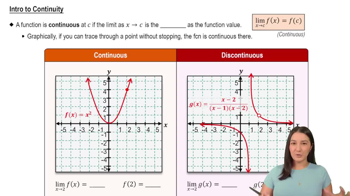
Intro to Continuity

Limit of a Function as x Approaches a Point

The limit of a function as x approaches a point describes the value that the function output approaches near that point. For (sin x)^x as x approaches 0 from the right, evaluating the limit helps determine the function's behavior and the appropriate continuous extension at x = 0.
Recommended video:
06:11
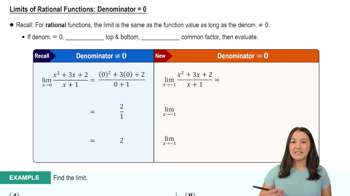
Limits of Rational Functions: Denominator = 0

L’Hôpital’s Rule

L’Hôpital’s Rule is a method to evaluate limits that result in indeterminate forms like 0^0, 0/0, or ∞/∞. It involves differentiating the numerator and denominator separately and then taking the limit again. This rule is useful for finding lim(x→0⁺)(sin x)^x by transforming the expression into a form suitable for differentiation.
Recommended video: