
Textbook Question
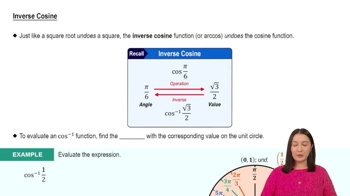
Use reference triangles in an appropriate quadrant to find the angles in Exercises 1–8.
1. c. tan^(-1)(1/√3)

 Verified step by step guidance
 4:49
4:49
 05:53
05:53 05:14
05:14Use reference triangles in an appropriate quadrant to find the angles in Exercises 1–8.
1. c. tan^(-1)(1/√3)
c. Find the slopes of the tangent lines to the graphs of f and g at (1, 1) and (−1, −1) (four tangent lines in all).
10. True, or false? As x→∞,
c. 1/x - 1/x² = o(1/x)
In Exercises 41–44:
c. Evaluate df/dx at x = a and df⁻¹/dx at x = f(a) to show that
(df⁻¹/dx)|ₓ₌f(a) = 1 / (df/dx)|ₓ₌a
44. f(x) = 2x², x ≥ 0, a = 5
23. Human evolution continues The analysis of tooth shrinkage by C. Loring Brace and colleagues at the University of Michigan’s Museum of Anthropology indicates that human tooth size is continuing to decrease and that the evolutionary process has not yet come to a halt. In northern Europeans, for example, tooth size reduction now has a rate of 1% per 1000 years.
c. What will be our descendants’ tooth size 20,000 years from now (as a percentage of our present tooth size)?
88. Given that x>0, find the maximum value, if any, of
c. x^(1/x^n) (n a positive integer)